Agentic AI in HR: Redesigning the Talent Lifecycle with Autonomous Intelligence
Learn what AI agents are—and the role they should play in your HR strategy


Contents
- 01 What is agentic AI?
- 02 Master Agentic HR in 4 tracks
- 03 What is agentic AI in HR?
- 04 How does agentic AI work in HR
- 05 How agentic AI transforms the talent lifecycle
- 06 How does agentic AI differ from traditional HR automation?
- 07 Why leaders must deconstruct work to use AI agents effectively
- 08 Best practices for leveraging agentic AI in HR
- 09 Predictions and strategic implications for agentic AI
First, everyone was talking about ChatGPT. Then the conversation moved to the rise of Gen AI as a whole. More recently, it’s agentic AI that’s been dominating everything from news headlines to boardroom discussions. But what exactly is it? And how does it apply to HR?
While AI agents may be a relatively new addition to the HR landscape-not to mention the working world at large-they have the potential to completely transform operating models and enable workforces to achieve peak performance and productivity.
What is agentic AI?
Agentic AI refers to artificial intelligence systems that can autonomously plan, make decisions, and execute complex tasks without continuous human intervention. Unlike traditional AI that simply responds to prompts, agentic AI uses advanced reasoning and tools to achieve specific, long-term goals by adapting to changing environments.
Master Agentic HR in 4 tracks
58 articles across 4 tracks. From foundations to implementation.
What is agentic AI in HR?
Agentic AI in HR represents autonomous software systems designed to independently pursue complex goals rather than just automate static tasks. These AI agents analyze data, make decisions, plan multi-step workflows, and execute HR processes—such as end-to-end recruitment or personalized onboarding—with minimal human intervention.
How does agentic AI work in HR
Agentic AI in HR works by leveraging advanced language models, feedback loops, and specialized tools to operate as an autonomous agent. Instead of waiting for direct prompts, the AI perceives HR data, creates multi-step execution plans, integrates with existing enterprise software, and self-corrects its actions to achieve complex, long-term human resource objectives.
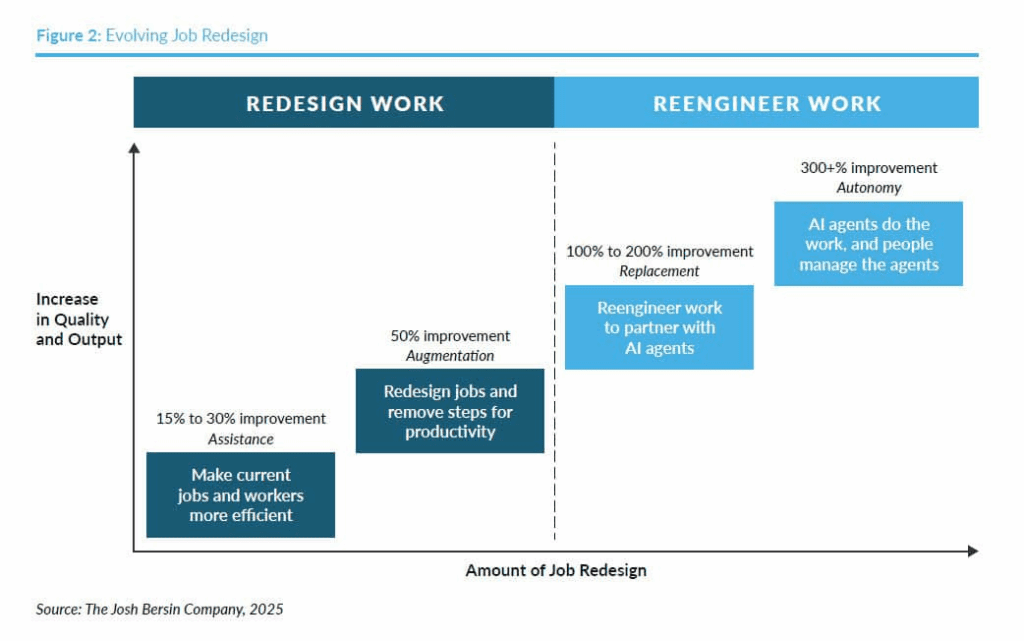
Josh Bersins Evolving Job Redesign
As part of his company’s HR 2030: The Journey to Agentic HR research program, Josh Bersin has outlined a detailed blueprint for how AI agents will reshape HR by the end of the decade.
According to the report HR functions are expected to become smaller and flatter, with headcount potentially reduced by 30 to 50 percent as up to 130 AI agents take on specialized tasks across 95 distinct HR-focused capabilities.
Rather than simply automating what exists, the research argues that organizations can unlock benefits that are 10 to 100 times more impactful than using AI to reduce headcount alone by using agents to improve hiring precision, accelerate reskilling, and enable faster entry into new markets.
Microsoft
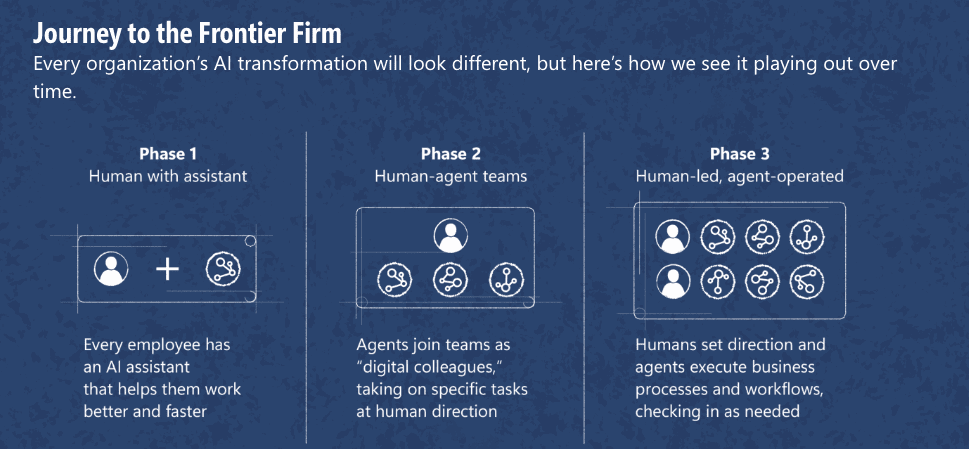
Agentic AI is such a hot topic that Microsoft recently published an entire report dedicated to “Frontier Firms”, or organizations that are powered by hybrid teams of humans + agents to generate value faster. They break down the journey to becoming a Frontier Firm into three stages that range from humans using AI assistants to human-agent teams and finally human-led, agent-operated organizations.
Microsoft also introduces new vocabulary to navigate our agentic AI age, including “Agent Boss” (a person who manages one or more AI agents) and “Human-Agent Ratio” (a metric that optimizes the balance of human oversight with agent efficiency on human-agent teams).
Writer
Writer offers yet another way to think about the rise of agentic AI, which breaks down agentic systems into four distinct levels. The first, Assistive Agent, is about using LLMs to automate simple tasks, while the final level, Multi-Agent Systems, involves networks of agents that come together to accomplish a singular goal.
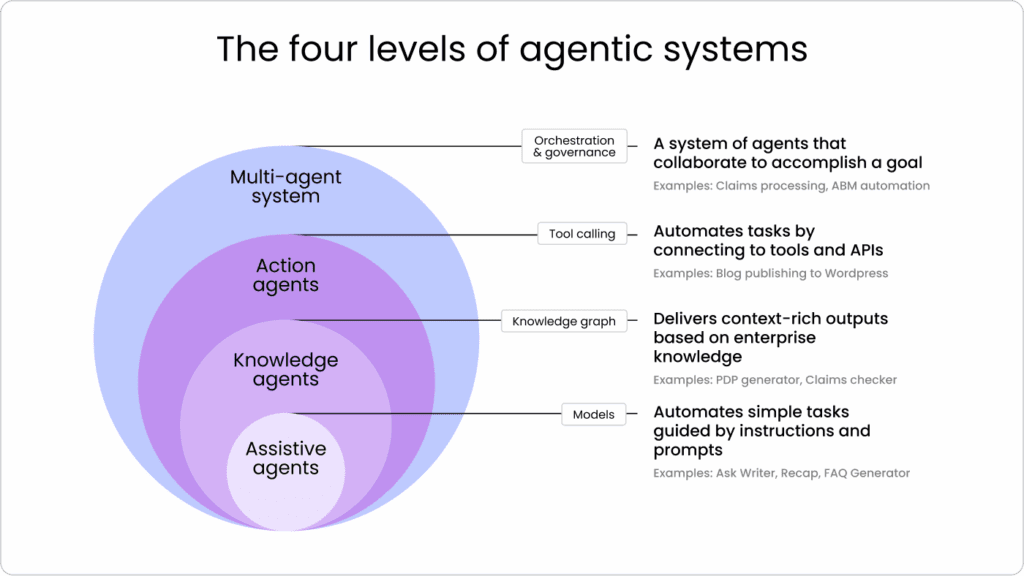
While each framework has its own system for breaking down the rise of agentic AI, ultimately the overarching takeaway is that agentic AI is so much more than an automation layer; it’s an autonomous collaborator that understands goals, makes decisions, and has the ability to execute actions across the employee lifecycle.
How agentic AI transforms the talent lifecycle
Agentic AI transforms the talent lifecycle by automating sourcing, personalizing development, and enhancing workforce planning. The rise of agentic AI will fundamentally change how work gets done across all functions – and HR is no exception. In fact, it has the potential to impact the talent lifecycle from end-to-end in the following 5 ways:
#1. Autonomous talent sourcing and matching
As the competition for in-demand skills intensifies and talent shortages grow more severe, companies are prioritizing internal mobility over external hiring to fill vacancies and bridge knowledge gaps. To enhance this process, agents can identify and surface internal candidates based on skill adjacencies, experience, and aspiration signals. For example, a company can create an internal mobility agent to match frontline employees to newly posted project roles in real time.
#2. Employee onboarding, training, and development
AI agents have the potential to help us change L&D processes as we know them. These systems can autonomously onboard new hires by scheduling training, answering FAQs, and provisioning tools. Learning agents can also personalize development pathways so that they’re tailored to individual employee ambitions and pressing business needs and nudge team members to complete action items within their development plans.
#3. Performance management and feedback
Performance management can’t be a once-a-year discussion; instead, leaders should always monitor how employees are progressing. Continuous listening agents make that possible by gathering feedback signals such as project reviews and engagement inputs to provide real-time performance snapshots. AI can also draft input summaries, identify coaching needs, and propose growth opportunities.
#4. Employee experience and engagement
Leaders who are looking to improve employee satisfaction can turn to conversational agents to act as always-on support hubs that can give employees the answers they’re looking for in mere seconds. If organizations are trying to assess potential turnover risks and keep burnout at bay, executives should consider engagement agents to analyze tone and employee feedback patterns.
#5. HR analytics and strategic workforce planning
In our fast-paced, ever-evolving world of work, leaders must use data to stay one step ahead of emerging skill needs and impending knowledge gaps. Agents can ingest workforce, business, and market data to autonomously run workforce planning scenarios, build skill forecasts, and detect gaps in talent strategies.
How does agentic AI differ from traditional HR automation?
The main difference between agentic AI and traditional HR automation is that agentic AI acts autonomously, making real-time decisions using dynamic data. Traditional HR automation relies on static rules and requires human intervention to adapt.
For example, in traditional HR automation, a workflow rule will move a candidate from one stage of the hiring process to the next. In contrast, agentic AI can evaluate candidate quality, make recommendations to reassign an existing employee to a relevant team, and notify all managers involved.
Why leaders must deconstruct work to use AI agents effectively
Before deploying AI agents, executives must first understand what work exists within their organization and how this work can be viewed as disparate tasks that build on one another to accomplish a deliverable. Leaders should first break roles into discrete units of work, then consider the skills each of these tasks require and who possess them (humans versus AI), and finally determine where agents can augment, automate, or own distinct tasks and processes.
The urgency to redesign, not just deploy, is backed by the data. McKinsey’s 2025 State of AI survey found that while 88% of organizations use AI in at least one business function, only approximately 6% of respondents report that AI has driven an earnings impact of 5% or more. The differentiating factor: organizations reporting significant financial returns were far more likely to have redesigned end-to-end workflows before selecting their AI tools, rather than layering AI on top of existing processes.
Best practices for leveraging agentic AI in HR
Regardless of where your organization is in its AI transformation journey, the following 4 best practices can help you make the most of agentic AI:
#1. Embed human-in-the-loop (HITL) systems
Regardless of how advanced agentic AI becomes, human oversight will always be non-negotiable. The best employee-AI collaborations go beyond prioritizing a human-in-the-loop approach and instead make it all about being human-at-the-helm. That means that humans aren’t just checking over the work AI agents do; they’re actively involved in directing, reviewing, and governing all agentic activity.
#2. Align AI goals with business and HR strategies
Just like human employees, your AI agents should be oriented in bigger-picture business objectives rather than merely focusing on task completion. For example, an onboarding agent should go above and beyond ensuring employees complete L&D coursework and instead set new hires up to maximize performance and productivity by making sure they have access to all the tools and learning pathways they’ll need.
#3. Conduct regular audits and model reviews
Just because AI agents are capable of acting autonomously, doesn’t mean that these systems won’t benefit from regular audits and model reviews. In fact, given the vast array of responsibilities agents can take on, leaders must go the extra mile to continuously evaluate agent decisions and behavior. Executives should prioritize explainability and ensure they can understand the reasoning behind agentic AI’s actions, especially for decisions regarding talent management and workforce planning.
#4. Promote digital literacy and AI literacy across the workforce
Agents are only as impactful as the humans who know how to guide and work alongside them. Consequently, leaders must develop strategies to build basic AI literacy, much like executives encourage employees to improve their overall digital skills. AI literacy training should be mandatory, ongoing, and distributed amongst people of all seniority levels and business functions.
Predictions and strategic implications for agentic AI
Agentic AI shouldn’t be part of leaders’ vision for the future of work; instead, it must be part of every organization’s current reality. Agents are increasingly becoming the “third team member”—not just supporting employees and managers, but owning specific outcome areas.
Businesses will need new governance models for AI agents that cover task ownership, potential risks and mitigation strategies, and insight into how these systems are evolving. As a result, HR’s role will shift from owning distinct processes like onboarding and L&D to becoming the overarching orchestrator of dynamic, distributed human and machine talent ecosystems.
Want to learn more about the rise of agentic AI and how it’s transforming work for both managers and individual contributors? Find out more in our Agentic HR Academy.