Platform / Workday

Make Skills Cloud actually intelligent.

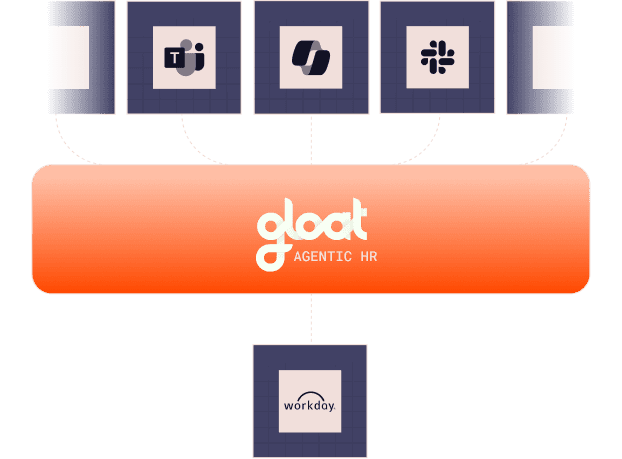
Workday holds your workforce data. Gloat puts intelligent agents where your people already work—Teams, Slack, email. Agents that build succession pipelines, catch flight risks, and coach careers without anyone logging into an HCM.
Group 3466773
The reality for most Workday customers

Workday captures the data. It runs the transactions. But employees don't live in Workday—they live in Teams, Slack, and email. The intelligence needs to meet them there, proactively, in the flow of work.

01 <5

Skills per employee in Skills Cloud

Self-reported skills are sparse and stale. Employees add a few during onboarding and never return. The taxonomy exists but the data is thin.

02 Quarterly

Talent pool refreshes

Pools are built manually by HRBPs, reviewed in talent forums, and outdated within weeks. People grow faster than lists update.

03 Generic

Career Hub recommendations

Career Hub shows open positions by job family. No real personalization. No connection to actual skills or aspirations beyond what’s in the profile.

04 Headcount

Workforce planning lens

Plans model people as numbers—”we need 10 more.” No visibility into which specific skills are missing or where internal supply could fill the gap.

What if Skills Cloud had 10x the data?

Agents that infer skills from real work, maintain living talent pools, personalize Career Hub, and turn workforce planning from headcount math into capability strategy.

CHALLENGE

Skills Cloud data is thin

TODAY

Employees self-report a handful of skills. Managers rarely validate. The result: a skills taxonomy that's rich in structure but sparse in actual data.

WITH GLOAT

Agents infer skills from work output across all systems—project deliverables, code commits, certifications, collaboration patterns. Skills Cloud becomes the taxonomy; Gloat fills it with evidence.

CHALLENGE

Talent pools are static lists

TODAY

You build talent pools in Workday once a quarter. By the time you need them, people have moved, grown, or left. Pools decay faster than they're refreshed.

WITH GLOAT

Agents maintain living talent pools that update daily. Readiness scores shift as employees gain experience. New candidates surface automatically as their profiles evolve.

CHALLENGE

Career Hub feels like a dead end

TODAY

Employees visit Career Hub, see a list of open roles, and leave. No personalization beyond job family. No connection to their actual skills or aspirations.

WITH GLOAT

Every employee sees paths tailored to their real capabilities—including roles they wouldn't have searched for. Development actions are specific, sequenced, and tracked.

CHALLENGE

Workforce planning is headcount math

TODAY

Planning models count people, not skills. You know you need "10 more engineers" but not which specific capabilities are missing or where the surplus sits.

WITH GLOAT

Agents map skills supply against strategic demand in real time. Plans identify specific capability gaps and propose upskilling, redeployment, or hiring—with cost and timeline for each.

Governance

Your security model. Agents operate within it.

Workday's security architecture is among the most sophisticated in enterprise software—domain security policies, integration system security groups, configurable business processes. Gloat agents are bound by all of it. They authenticate through your tenant, respect your ISSG boundaries, and trigger actions through your configured business process definitions.

Business process definitions

Workday's configurable business processes—approvals, notifications, conditions—took years to build. Gloat agents trigger within them. A promotion recommendation follows the same approval chain whether initiated by a manager or an agent.

Security groups

Workday's role-based security is granular and carefully configured. Agents see only what the requesting user can see. No data leaks across security boundaries. Your ISSG and domain security policies apply to every agent action.

Tenant-level isolation

Integration runs within your Workday tenant's security perimeter. API credentials are tenant-scoped. Data processing respects your configured data residency. Audit logs capture every read and write.

Outcomes

Measurable from day one

01 5x

more skills captured per employee

Agents infer from real work, not self-reports

02 60%

reduction in time-to-fill internal roles

Agents surface candidates before reqs go external

03 2.8x

increase in internal mobility

Career coaching delivered in Teams and Slack

04 35%

improvement in workforce plan accuracy

Continuous skills supply vs. strategic demand

Integration Architecture

Native API integration. Workday stays your system of record.

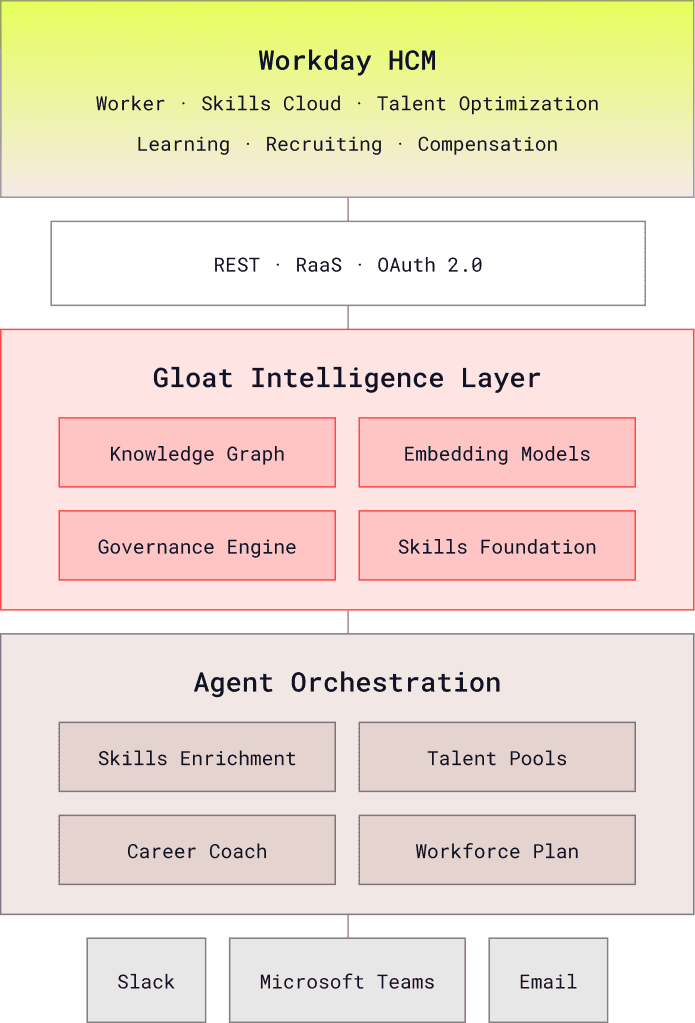
Gloat reads your Workday data through native APIs, builds an intelligence layer, and delivers agents where employees already work—Teams, Slack, email. Employees get career coaching, managers get succession insights, HR gets proactive alerts. Workday stays your system of record. Agents bring it to life.

Protocol: REST + RaaS Native Workday REST API for real-time queries; RaaS for scheduled data extraction and custom reports
Authentication: OAuth 2.0 Refresh token flow, ISU (Integration System User) with scoped security groups
Sync model: Event-driven + scheduled Workday integration events for real-time changes; RaaS reports on configurable schedule for full reconciliation
Write-back: REST API Native Workday REST API for skill updates, development plans, succession nominations, and bulk operations
Hosting: Customer's region Deployed in the same cloud region as your Workday tenant. SOC 2 Type II certified. Data never leaves your region
Group 3466771
FAQ

Questions we hear

How does this relate to Workday Skills Cloud?

Skills Cloud provides the taxonomy—the structure of skills and their relationships. It's excellent at that. What it lacks is data density. Most organizations have fewer than 5 skills per employee in Skills Cloud. Gloat agents infer skills from actual work across all connected systems and write them back, making Skills Cloud dramatically more useful.

What about Workday Illuminate?

Illuminate adds AI capabilities to Workday transactions—better search, generated job descriptions, summarization. It makes Workday easier to use. Gloat agents do something structurally different: they reason across multiple systems, monitor signals continuously, and take autonomous action. Illuminate optimizes Workday usage; Gloat agents solve workforce problems that span beyond any single system.

Does this replace Workday Recruiting or Talent Optimization?

No. Workday remains your system of record for all formal processes. Gloat adds an intelligence layer that makes those processes smarter. Your recruiting process still runs in Workday—but with internal candidates surfaced by agents who understand skills across systems. Your talent reviews still happen in Workday—but informed by continuous signals rather than point-in-time data.

How does the integration work technically?

We use Workday's native RaaS (Report-as-a-Service) for data extraction and REST APIs for real-time queries. Write-back uses the REST API for individual records and bulk operations. Authentication is OAuth 2.0 with refresh tokens. Change detection uses Workday's integration event framework.

What data do you read from Workday?

Worker profiles, job history, skills (from Skills Cloud), compensation bands, org hierarchy, learning completions, talent assessments, succession plans, and business process configuration. We read governance rules so agents respect your existing approval workflows. You control the exact scope during implementation.

How long does implementation take?

Workday integration setup takes 2-3 weeks—configuring RaaS reports, API credentials, and security groups. Agent configuration and tuning takes 4-8 weeks depending on use case complexity. Most customers are live with their first agent within 90 days. Start with one high-impact use case and expand.


See it on your Workday data

We'll show you what agents find in your Skills Cloud, talent pools, and career pathways—in your tenant, with your data.