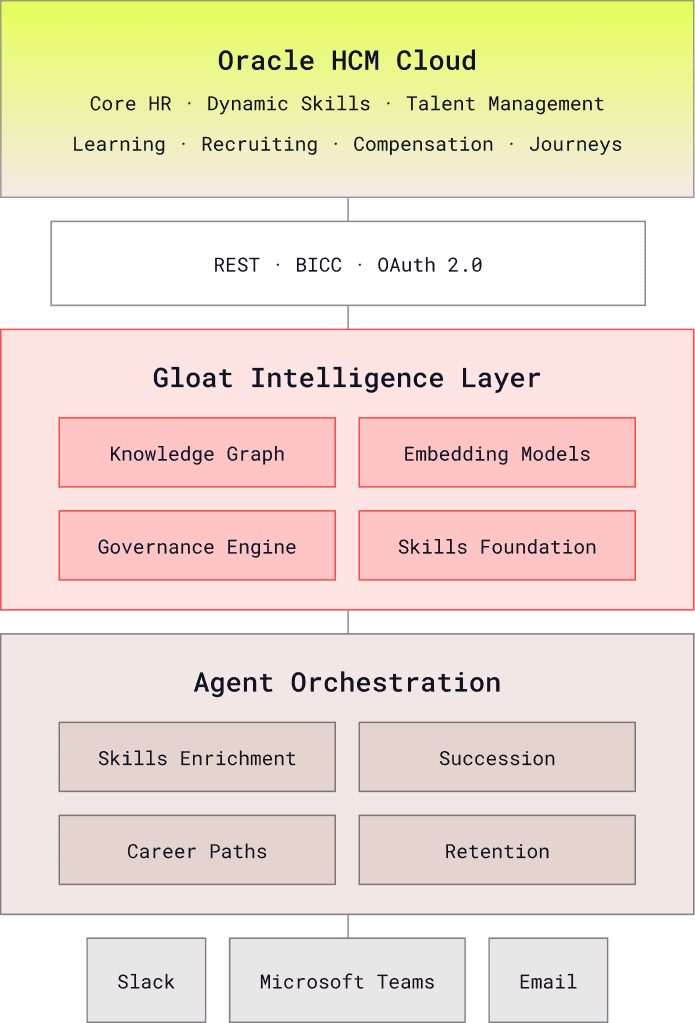
Oracle HCM Cloud holds your workforce data. Gloat delivers intelligent agents where your people already work—Teams, Slack, email. Agents that coach careers, build succession pipelines, and flag retention risks proactively, without anyone opening Oracle.
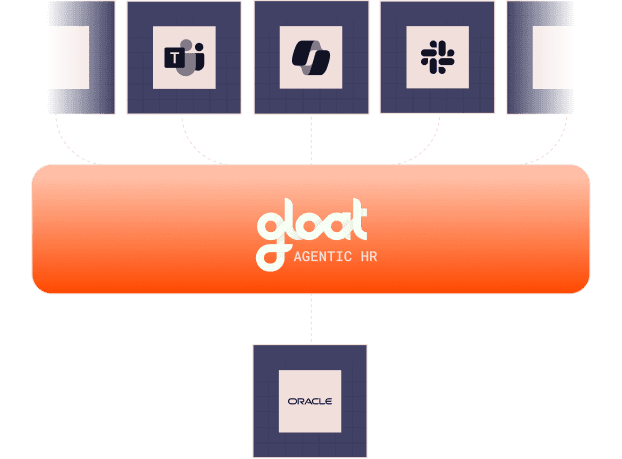
Oracle HCM captures the data. Dynamic Skills and ME are real innovation. But your people don't live in Oracle—they live in Teams, Slack, and email. The intelligence needs to meet them there, proactively, in the flow of work.
Dynamic Skills profiles
Oracle’s Dynamic Skills framework is sophisticated. But employee engagement with skill self-assessment is low, and the AI can only infer from Oracle-visible data.
Talent Review cycles
Reviews follow HR calendars, not business reality. Critical talent shifts happen between cycles. By the next review, the landscape has changed.
Opportunity visibility
Grow and ME surface Oracle-managed opportunities. But roles, projects, gigs, and mentorships in non-Oracle systems stay invisible to employees.
Retention response
Flight risk indicators exist in the data but aren’t monitored continuously. Interventions happen after disengagement signals have compounded.
Oracle built powerful frameworks. Gloat agents fill them with data from every connected system — turning sparse profiles into rich intelligence and static journeys into personalized paths.
Dynamic Skills adoption is slow
Oracle's Dynamic Skills capability is powerful in theory. In practice, employees engage minimally. Skill profiles stay sparse. The AI recommendations improve but the input data limits them.
Agents infer skills continuously from every connected system—project outcomes, certifications, code repositories, collaboration tools. Dynamic Skills becomes the framework; Gloat ensures the data is comprehensive and current.
Talent Review is a point-in-time exercise
Talent reviews happen on a cadence. Between reviews, readiness changes, people leave, new candidates emerge. The review deck is outdated before the meeting ends.
Agents maintain continuous talent signals. Readiness scores update daily. When a review meeting happens, the data is current—and between meetings, agents flag critical changes that can't wait for the next cycle.
Journeys are static paths
Oracle Journeys provides guided workflows—onboarding, role changes, life events. They're well-designed but predetermined. They can't adapt to individual employee context or cross-system signals.
Agents personalize each employee's journey using data from every connected system. An onboarding journey adapts based on inferred skills, team dynamics, and relevant projects. No two paths are the same.
Grow recommends from a narrow pool
Oracle Grow suggests learning and opportunities based on what it can see—Oracle data. Employees in mixed-vendor environments miss opportunities that live in other systems.
Agents recommend opportunities from everywhere—internal gigs, projects, mentorships, courses across LMS platforms, stretch assignments—and connect them to a unified development plan that writes back to Oracle.
Oracle HCM's governance isn't just configuration—it's institutional knowledge. Approval chains reflect organizational structure. Data roles encode information boundaries. Business rules capture compliance requirements. Gloat agents read this governance layer and operate strictly within it. No shortcuts, no workarounds, no shadow processes.
Oracle's approval rules—multi-level chains, delegation, conditional routing—have been refined over years. Gloat agents submit actions through these existing chains. A compensation change recommended by an agent follows the same approval path as one initiated by a manager.
Oracle HCM's data role security defines precisely who sees what data. Agents authenticate as an integration user with scoped data roles. An agent serving a manager shows only their direct and indirect reports. An employee-facing agent shows only their own data and public opportunities.
Every agent action generates an audit record: what was accessed, what was recommended, what action was taken. These records integrate with Oracle's existing audit framework, giving compliance teams a single view of both human and agent-initiated actions.
more internal candidates per open role
Agents surface talent proactively in manager channels
faster leadership pipeline development
Continuous signals, not annual review cycles
reduction in external hiring spend
Agents match internal talent before reqs go external
to first measurable impact
Integration setup + agent configuration + live
Gloat reads your Oracle HCM data through native APIs, builds an intelligence layer, and delivers agents where employees already work—Teams, Slack, email. Employees get career coaching, managers get succession insights, HR gets proactive alerts. Oracle stays your system of record. Agents bring it to life.
Dynamic Skills provides Oracle's AI-driven skills framework—skill suggestions, proficiency tracking, growth recommendations. Gloat doesn't replace it. We enrich it. By inferring skills from systems Oracle can't see (project tools, collaboration platforms, external certifications), we dramatically increase the data density that makes Dynamic Skills more effective. Think of it as pouring fuel into the engine Oracle built.
Oracle ME is a brilliant employee experience layer; Grow connects learning to career goals. Both are limited to Oracle's data perimeter. Gloat agents extend that perimeter—finding opportunities in non-Oracle systems, inferring skills from non-Oracle data, and creating a richer, more personalized experience. ME and Grow improve; they don't get replaced.
Yes. Gloat integrates natively with Oracle HCM Cloud (Fusion). We use Oracle's REST APIs for real-time data access, BICC for bulk data extraction, and HDL/HCM Data Loader for write-back. If you're on Oracle Fusion HCM, the integration is straightforward and well-tested.
Agents can initiate actions that flow through Oracle's configured business processes. For example, an agent might recommend a role change that triggers your configured approval chain, or suggest a learning assignment that gets enrolled through your Oracle Learning instance. The agent proposes; your business processes govern.
Core HR data (worker records, job history, org hierarchy), talent management data (goals, performance, potential ratings), skills data (Dynamic Skills profiles), learning completions, compensation structures, and succession plans. You configure the exact scope. We also read your approval rules and security configuration so agents respect your governance.
Oracle integration setup typically takes 2-4 weeks—configuring BICC extracts, REST API credentials, and data role permissions. Agent configuration and testing takes 6-8 weeks. Most customers are live within 90-120 days. We work with your Oracle admin team throughout. Start with one use case (succession or skills enrichment are common starting points) and expand.
Get Started
We'll connect to your Oracle environment and show you what agents find—skills gaps, succession risks, and career opportunities hiding in your data.