Work Fluidity in Action: 5 Key Takeaways from Holcim’s AI Transformation Journey
David Green sits down with Holcim and Gloat to explore what the 5% winning with AI do differently

The statistics are stark: according to recent MIT research, 95% of AI programs are failing to deliver meaningful productivity gains. But as Jeff Schwartz, VP of Insights and Impact at Gloat, points out, there’s more to this headline than meets the eye.
“People are quoting the headline from this MIT report… It’s the most quoted headline I’ve seen in a couple of years, but it’s probably among the least read reports out there,” Schwartz explains. “The report does not say that we are doomed to fail with GenAI and Agentic AI. Rather, it says we’ve studied what’s going on, and there’s a difference between people who are making progress and people who aren’t.”
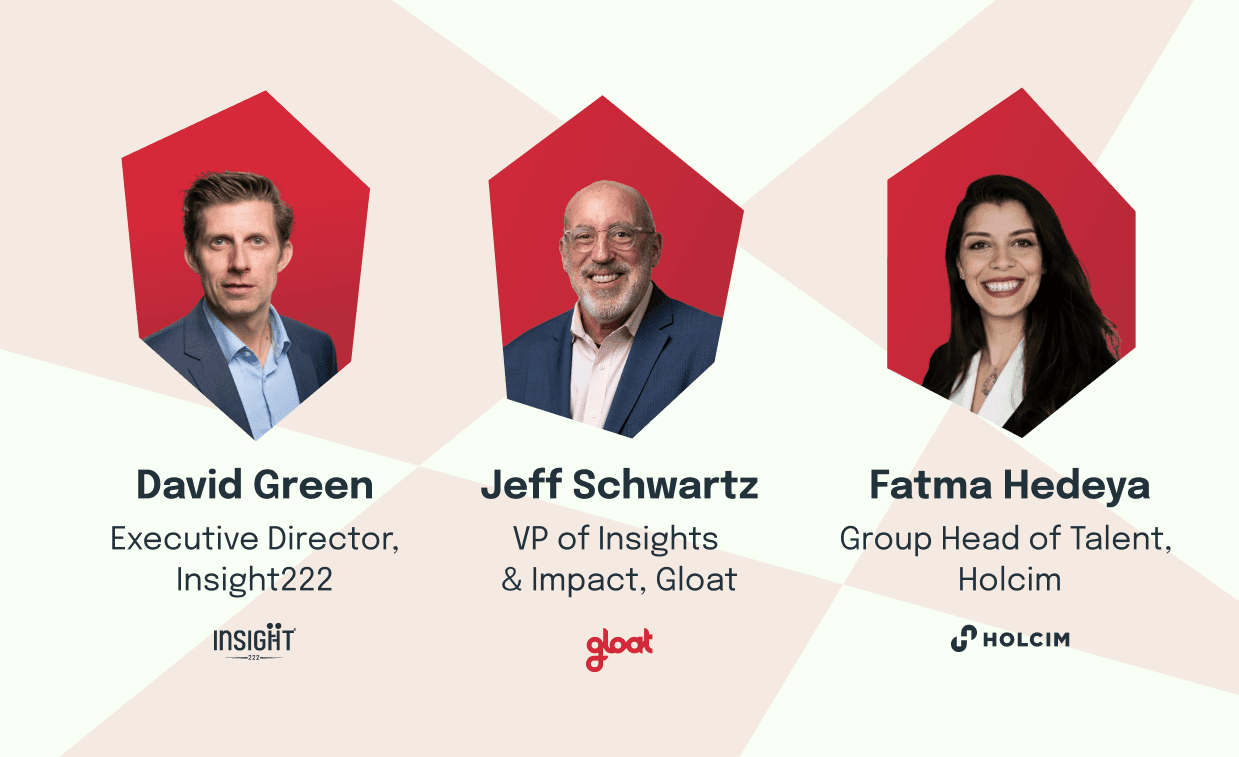
During a recent panel discussion, Schwartz joined Fatma Hedaya, Group Head of Talent at Holcim, and David Green, Managing Partner at Insight222 and host of the Digital HR Leaders podcast, to explore what separates the winners from those falling behind.
As Green framed it at the outset: “The five percent of companies that are winning with AI, we sense that they’re pulling away from the pack. They’re focusing on work over jobs. They’re empowering managers at scale. And they’re driving AI mastery in the flow of work. These companies don’t just view this as a technology implementation or a technology transformation. They view it very much as a people transformation.”
That people-first philosophy runs through every insight shared during the conversation—and offers a practical roadmap for HR leaders navigating this pivotal moment in workforce transformation.
5 key lessons for building workforce AI strategies that work
If you’re looking to move beyond pilots and drive real AI impact in 2026, consider these insights from leaders who are making it happen:
#1. Start with work and business outcomes—not technology
The companies succeeding with AI aren’t treating it as a technology implementation. They’re approaching it as a fundamental reimagining of how work gets done.
“Companies that are successful with their AI strategy are not looking at this as a technology problem alone,” Schwartz emphasizes. “One of the biggest challenges is putting business outcomes and business solutions as the cornerstone as to how you’re framing this, and connecting work and business outcomes with workforce and skills with technology.” This means starting every AI initiative by asking: What problem are we solving? What business outcome are we trying to achieve? Only then should technology enter the conversation.
Hedaya’s experience at Holcim reinforces this approach. When a finance project posted on their internal talent marketplace received no applicants, she helped the team realize they weren’t actually looking for one person with finance skills; they needed multiple people with data science, machine learning, and business development capabilities.
“To accomplish one seemingly finance-oriented project was actually nine activities. Maybe one of them required financial skills, and all of the rest required skills that do not sit in finance,” Hedaya explains. “The work is going to dictate who works on what and at what percentage.”
#2. Decouple jobs, people, and skills
One of the most significant mindset shifts separating successful organizations from the rest is moving beyond traditional job-centric thinking. “We are actually decoupling jobs, people, and skills,” Hedaya explains. “Historically, we always used these as synonyms, but it’s no longer the case. Your skills are different from who you are as a person. They’re different from your job title. We are trying as a business to get the best out of those three things.”
This decoupling enables what Hedaya calls “work fluidity”—the ability to dynamically match skills to work regardless of traditional organizational boundaries. At Holcim, this approach has produced striking results: nearly 50% of projects on their talent marketplace are cross-functional, and half are multi-geographic.
Schwartz ties this to broader workforce trends. Referencing McKinsey research, he notes that work is becoming increasingly project-based rather than process-driven. “If it’s a standard process, robots or AI or some technology is going to do it. More of our work will look like projects.” The implication for HR leaders: stop thinking about headcount and job requisitions, and start thinking about how to orchestrate work and capabilities across the organization.
#3. Think of yourself as head of sales
Perhaps the most unconventional advice comes from Hedaya, who describes her role as “head of sales” in addition to head of talent. “The era of HR sitting in their ivory tower with their white gloves on, sending one email and thinking things are going to resolve itself, is over,” Hedaya states. “You have to be strategic. You have to understand the business. But that doesn’t mean you are distant.”
This sales mindset means deeply understanding each stakeholder’s specific angle on business problems, not just presenting solutions. When Hedaya was building the case for adopting Gloat at Holcim, she held individual conversations with every executive committee member.
“I would sit with our executive committee and talk about our business problems in the meeting. But then I would go speak to every single member about their angle of the business problem,” she explains. “Some people are interested because they want visibility over everybody. Others want to create very cool things and don’t have the capacity within their organization.”
This relationship-building creates the trust necessary to experiment with unproven approaches. When a senior leader asked Hedaya point-blank, “Does it work?” she responded honestly: “I don’t know.” His response—”If we never try, we’ll never know. Let’s do it”—came from the trust built through meaningful conversations, not a polished pitch deck.
#4. Include HR from the start or pay the price later
One of the most compelling arguments for HR’s central role in AI strategy is purely financial: excluding HR from the conversation is simply too expensive. Hedaya shares a recent experience where she brought AI impact data to a senior function head at Holcim. “We are investing a lot in AI in that specific function. And I asked, ‘What’s the plan?’ They had no answer.”
The consequences of this disconnect are significant. “There are two scenarios. One, we’re going to implement everything, and we’re going to have to do major restructuring because our workforce has not been trained to use AI. Or the other way around, they’re just not going to use the technology, and we’re going to completely throw our investments down the drain.”
This isn’t just about avoiding negative outcomes; it’s about enabling positive ones. Schwartz notes that according to the MIT research, the companies achieving real AI impact “are seeing relatively small impacts on their workforce because their workforce is more productive. The bigger savings are reduced BPO (Business Process Outsourcing) expenditure and reduced external party spending.” These insights only emerge when HR is at the table from the beginning, helping leaders understand how work, workforce, and technology intersect.
#5. Think change acceleration, not change management
The final lesson challenges HR to rethink their fundamental approach to transformation.
“It’s not ‘is it with AI?’—because AI is probably going to get everywhere eventually. It’s the pace at which you get there,” Schwartz explains. “That could be the competitive differentiator.”
This reframe—from change management to change acceleration—has profound implications. Research from BCG and Columbia Business School reveals a troubling perception gap: senior executives describe AI in optimistic terms around opportunity and growth, while frontline employees focus on job loss and anxiety.”How do I close that gap so that there is a clear narrative and a clear strategy that is understood at different levels?” Schwartz asks. “That’s part of the challenge for 2026.”
Hedaya emphasizes that learning initiatives must connect to real motivation. “You have to provide a reason why people would want to take this training. It could be because you can get better at your job, you can get promoted, or simply if you don’t take this, you probably will not be able to keep your job.” The organizations succeeding with AI aren’t just managing change; they’re creating the conditions for people to embrace it.
Take your organization’s AI transformation to the next level with Gloat
As Schwartz concludes, “Think of yourself as a salesperson, as an architect, as an orchestrator,and be deep into the business impact discussions with your teams and with the leaders you’re trying to support.”
2026 is about moving beyond piloting to real impact. The 5% that are winning with AI have figured out how to connect work, workforce, and technology in ways that deliver measurable business outcomes while developing their people.
Ready to join them? Watch the full conversation featuring Fatma Hedaya and Jeff Schwartz to learn how leading companies are building AI workforce strategies that actually work.