Rising Demand for AI Skills in the U.S. Job Market
What CHROs need to know about the AI talent crunch—and how leading organizations are closing the gap




Let’s talk about something that’s probably been keeping you up at night: the AI skills gap. If you’re an HR leader, you’ve likely watched the demand for AI talent skyrocket while wondering how on earth your organization is supposed to keep pace. You’re not alone. The numbers are staggering, the pressure is real, and the solutions aren’t always obvious.
The good news: this isn’t an unsolvable problem. But it does require understanding the landscape: why demand is surging, what skills actually matter, and how the smartest organizations are responding. Let’s dive in.
Why are AI Skills In Such High Demand?
AI skills are in high demand because nearly 90% of organizations now use AI in operations, yet only 9% have achieved AI maturity. Generative AI tools are widely adopted by workers, creating a skills gap. Companies also face pressure as AI-exposed industries report 4× higher productivity growth than others.
Enterprise AI Adoption and Digital Transformation
According to McKinsey’s 2025 State of AI report, nearly nine out of ten organizations now regularly use AI in their operations. That’s a massive leap from just a few years ago, and it signals that AI has moved from pilot projects to production deployments across core business functions.
Despite this widespread enthusiasm, Gartner found that only 9% of organizations have reached true AI maturity. The gap between adoption and optimization is where the skills shortage bites hardest. Companies have the tools—they just don’t have enough people who know how to use them effectively.
Generative AI and the Democratization of AI Tools
Generative AI has been a game-changer, and not just for tech companies. McKinsey reports that 75% of knowledge workers already use AI tools in some form, often without formal company deployment. That’s the democratization effect in action: employees are finding ways to be more productive with AI, whether their organizations have a strategy for it or not.
This creates both opportunity and challenge. The opportunity? Your workforce is already experimenting with AI. The challenge? Without structured enablement, you’re leaving productivity gains on the table and potentially introducing risks around governance and security.
Competitive Pressure Across Industries
PwC’s 2025 Global AI Jobs Barometer reveals something that should make every executive take notice: industries most exposed to AI are experiencing nearly four times higher productivity growth than those least exposed. Since generative AI’s proliferation in 2022, productivity growth in AI-exposed industries jumped from 7% to 27%, while less-exposed industries actually saw a decline.
This isn’t about keeping up with competitors anymore; it’s about not getting left behind entirely. The companies mastering AI integration are pulling away from the pack at an unprecedented rate.
Key Trends in AI Skills Demand
Understanding the why is important, but let’s get specific about what’s happening in the talent market. These trends should inform how you think about your workforce strategy for the next 3-5 years.
Growth in AI-Related Job Postings
The demand numbers are remarkable. According to McKinsey’s latest workforce research, the number of workers in occupations where AI fluency is explicitly required has grown sevenfold in just two years—from approximately 1 million in 2023 to around 7 million in 2025. That’s the fastest-growing skill category in U.S. job postings.
AI-related job postings peaked at 16,000 per month in late 2024, and positions requiring generative AI skills have quadrupled over the past two years. The trajectory? Experts expect this to triple again by the end of 2025.
AI Skills Adoption Across Industries and Occupations
AI talent demand has expanded well beyond tech. According to McKinsey, three-quarters of AI skill demand is currently concentrated in three occupation groups—computer and mathematical roles, management, and business and financial operations—but healthcare, consulting, and even staffing firms are rapidly catching up.
Deloitte’s research shows that demand is rising for complementary skills too such as quality assurance, process optimization, and teaching as organizations redesign work to leverage AI. This means AI fluency isn’t just for your tech teams; it’s becoming essential across every function.
Wage Premiums for AI-Skilled Workers
If you needed more evidence that AI skills are valuable, look at the compensation data. PwC’s analysis of nearly a billion job ads found that workers with AI skills commanded a 56% wage premium in 2024—more than double the 25% premium from the previous year.
Think about what that means for your talent strategy. Hiring AI talent externally is expensive and getting more so. The economics increasingly favor developing these capabilities internally, but only if you have the right infrastructure to identify skill gaps and deliver targeted enablement.
AI as a Tool for Human Augmentation
Despite all the headlines about AI replacing workers, the data tells a more nuanced story. PwC’s research found that job numbers are actually growing in virtually every type of AI-exposed occupation, even those considered highly automatable. Between 2019 and 2024, even roles with high automation potential saw 38% job growth.
The real story? AI is augmenting human capabilities, not replacing them wholesale. McKinsey’s analysis shows that over 70% of skills sought by employers today are used in both automatable and non-automatable work. The future isn’t about humans versus machines; it’s about humans working alongside AI, with the most successful workers being those who can orchestrate both effectively.
The Widening AI Skills Gap
Now for the sobering reality. Gartner predicts that generative AI will require 80% of the engineering workforce to upskill through 2027. Meanwhile, the World Economic Forum estimates that nearly six in ten workers will require training before 2030.
The skills employers are looking for are changing 66% faster in AI-exposed jobs, according to PwC. That’s a velocity of change that traditional L&D approaches simply can’t match. And yet, only about 40% of organizations are providing the kind of immersive, hands-on training that actually develops AI proficiency.
Main Technical AI Skills in High Demand
Let’s get tactical. If you’re trying to understand what capabilities your workforce needs—or what to look for when hiring—these are the technical skills driving the most demand right now.
Machine Learning and Deep Learning
Machine Learning Engineer remains the single most in-demand AI job title across industries. These professionals design algorithms that allow systems to learn from data and improve over time. Deep learning specialists—who work with neural networks for applications like speech recognition and image processing—command even higher premiums. Understanding how to train, tune, and deploy ML models has moved from “nice to have” to “mission critical” for technical teams across virtually every industry.
Programming Languages for AI Development
Python dominates the AI landscape—it’s the lingua franca of machine learning and data science. But proficiency in R for statistical analysis, SQL for data manipulation, and increasingly Rust for performance-critical applications are all valuable complements.
Data Science and Analytics for AI Applications
AI is only as good as the data feeding it. Skills in data collection, cleaning, and management have become crucial—so much so that roles bridging data engineering and machine learning are among the fastest-growing job categories. Understanding how to prepare data for model training is a bottleneck at most organizations.
Natural Language Processing
NLP had the largest growth in demand among technical AI skills, with a 155% increase in job postings mentioning NLP capabilities. This makes sense—the dominant use case for large language models is chatbots and customer service automation, but NLP skills also power everything from document analysis to sentiment tracking.
Vacancy rates for NLP specialists hit 15% in 2024—double the national average—indicating severe supply constraints for this critical capability.
Computer Vision
Computer vision engineers develop systems that enable machines to interpret visual data—critical for applications ranging from quality control in manufacturing to autonomous vehicles. While more specialized than NLP, demand is growing steadily as use cases expand across industries.
Prompt Engineering for Generative AI
This is perhaps the most democratized AI skill and one every knowledge worker should develop. Prompt engineering involves crafting effective inputs to get the best outputs from generative AI tools. It’s not deep technical work, but it dramatically impacts productivity. Organizations that systematically build this capability across their workforce are seeing significant efficiency gains.
AI Frameworks and Libraries
Proficiency in TensorFlow and PyTorch has become nearly essential for anyone building AI systems. These frameworks have become industry standards, and familiarity with them is assumed for most technical AI roles. The learning curve is real, but so is the payoff in terms of employability and effectiveness.
Cloud Computing for AI Deployment
Gartner estimates that over 80% of enterprises will have deployed GenAI-enabled applications by 2026. Most of that deployment happens on cloud platforms like AWS, Google Cloud, and Microsoft Azure. Understanding how to deploy and scale AI solutions in cloud environments has become essential for turning prototypes into production systems.
How Employers Are Addressing the AI Skills Gap
The talent market for AI skills is brutally competitive, but the smartest organizations aren’t just competing for external talent; they’re building capabilities from within. Let’s look at what’s working.
Upskilling and Reskilling Programs
According to McKinsey’s research, 80% of tech-focused organizations say upskilling is the most effective way to reduce employee skills gaps. Yet only 28% are planning to invest in upskilling programs over the next two to three years. That gap represents both a risk and an opportunity.
Companies like IKEA have rolled out AI literacy training to over 40,000 employees. JPMorgan Chase, Mastercard, and S&P Global are implementing organization-wide AI enablement programs. The common thread? These aren’t just technical training initiatives; they’re strategic workforce transformation efforts that touch every function.
Deloitte’s analysis suggests that given AI talent shortages, replacing existing workers with AI-ready talent isn’t a silver bullet. The most effective approach combines targeted external hiring with systematic internal development, identifying employees with adjacent skills and providing structured pathways to AI proficiency.
Hiring for Potential and Training for AI
Employer demand for formal degrees is declining, especially for AI-exposed roles. PwC found that the percentage of AI-augmented jobs requiring a degree fell from 66% in 2019 to 59% in 2024. Organizations are increasingly prioritizing demonstrated skills and learning aptitude over credentials.
McKinsey’s research shows that employees hired based on skills are 30% more productive during their first six months compared to those hired primarily based on degrees. The implication? Build your hiring processes around validated capabilities and potential, then invest in developing AI-specific skills internally.
Partnerships with Educational Institutions
Forward-thinking organizations are partnering with universities and training providers to build talent pipelines. Companies like Intel and TSMC have launched apprenticeship programs specifically designed to develop AI and advanced manufacturing skills. These partnerships help address the supply-side challenge by shaping curriculum to match actual job requirements.
The key is moving beyond traditional campus recruiting to genuine collaboration on curriculum development and experiential learning opportunities. Organizations that invest in shaping the talent pipeline—rather than just competing for its outputs—are building sustainable competitive advantages.
Internal AI Academies and Learning Platforms
The most sophisticated approach? Building internal AI academies that provide structured learning paths, hands-on projects, and ongoing skill development. Bank of America uses AI-powered conversation simulation to help employees practice client interactions. At Accenture, AI tracks over 8,000 skills and matches employees with projects and learning opportunities.
What makes these programs work isn’t just the content; it’s the integration with actual work. The most effective skill-building happens when learning is embedded in the flow of work, not separated from it. Employees learn AI skills by applying them to real business challenges, with guidance and support to ensure they’re developing capabilities that create immediate value.
Turning Insight into Action
If there’s one thing this data makes clear, it’s that the AI skills gap won’t close itself. The organizations that thrive in the next decade will be those that take a strategic, proactive approach to workforce development—identifying where AI can deliver the most value, understanding what skills their people need to capture that value, and building systematic programs to develop those capabilities at scale.
That requires more than good intentions. It requires intelligence—real-time visibility into how work is actually getting done, where AI can have the greatest impact, and which skills gaps are most critical to close. It requires the infrastructure to deliver targeted enablement to the right people at the right time.
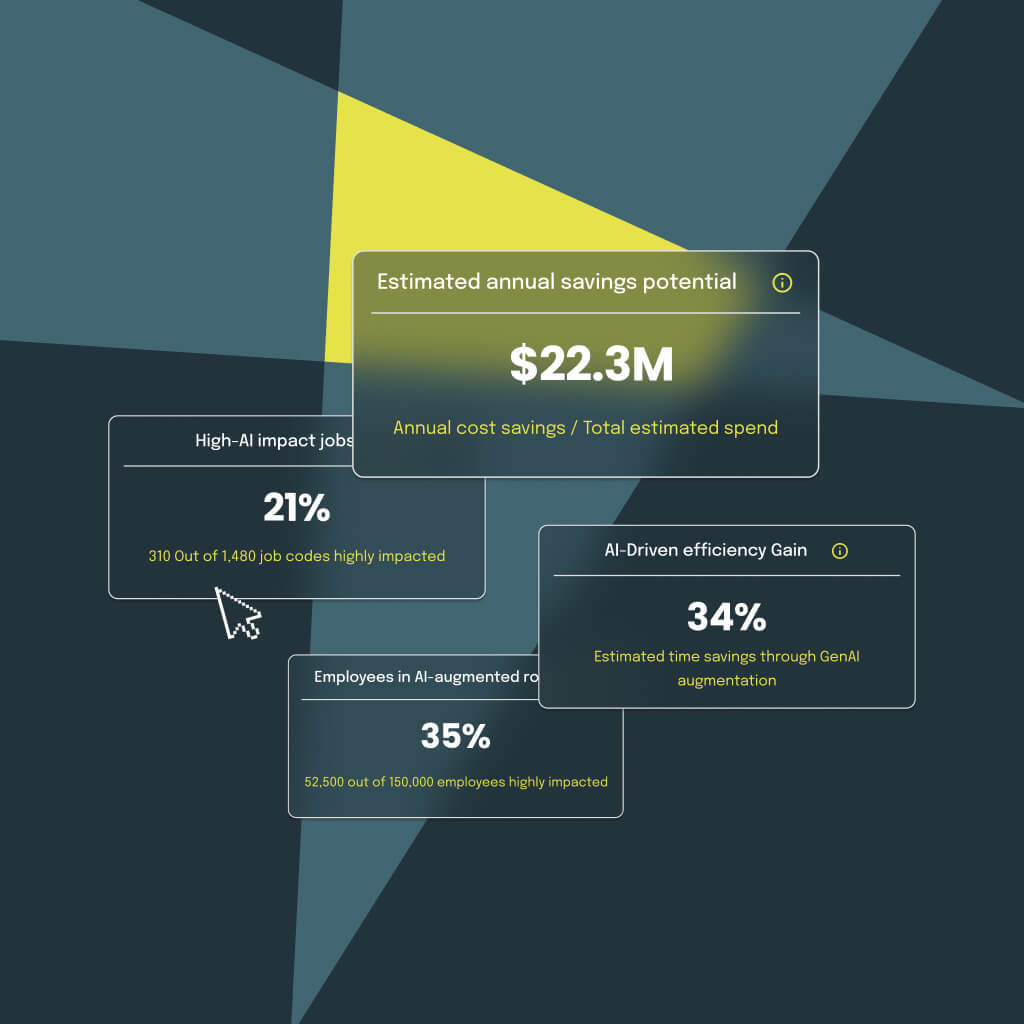
Ready to understand where AI can deliver the greatest ROI for your organization and what it will take to get there? Gloat Signal provides the intelligence layer you need to assess AI’s impact across your workforce, model potential savings, and prioritize the initiatives that will move the needle. Try Signal and start turning AI investment into real business impact.