The Headless HCM: How Agentic Intelligence Transforms What You Already Own
Your Human Capital Management implementation took a significant investment to build and the moment it went live, it started falling behind. The answer isn't better AI inside your HCM.

Contents
Your Human Capital Management implementation took years and significant investment to build. It holds years, maybe decades of workforce configuration, compensation history, and org logic. And the moment it went live, it started falling behind – built for a world of predictable workforce demands and rigid processes, where the cost of adapting to your specific business was so high that most organizations simply stopped asking.
That was a painful but manageable tradeoff in a slower-moving world. In an AI-driven one, the pace of change your business needs to keep up with has grown exponentially, and the gap between what your workforce requires and what your HCM can deliver has grown with it. At some point, your technology stops being something you work around, and starts limiting what your business can do. That’s not a tradeoff anyone can afford to make today where work is accelerating faster than any org chart can track, AI is becoming a working collaborator alongside your people, and the workforce your HCM was built to administer looks nothing like the workforce you’re actually trying to orchestrate.
When your HCM vendor layers AI onto that same architecture, it inherits the same constraints, dressed up differently. The intelligence is still trapped inside the same walls.
The answer isn’t better AI inside your HCM. It’s an intelligent layer above it.
This is the headless HCM moment. And the organizations that recognize it first won’t be the ones who survived the longest migration cycle – they’ll be the leaders who never started one.
What “Headless HCM” Actually Means
The architectural concept isn’t new – and that’s precisely the point.
The idea is simple: separating the user experience from the intelligence and data transforms our daily work – it sets the foundation to create role and process-specific experiences that no single vendor has contemplated.
The leading CRM platforms began exposing all their data through integrations, letting customers access and act on their data from any interface, any agent, any workflow. The adoption numbers were not pilot metrics. They were production-scale, agentic-over-system-of-record behavior at an accelerated pace.
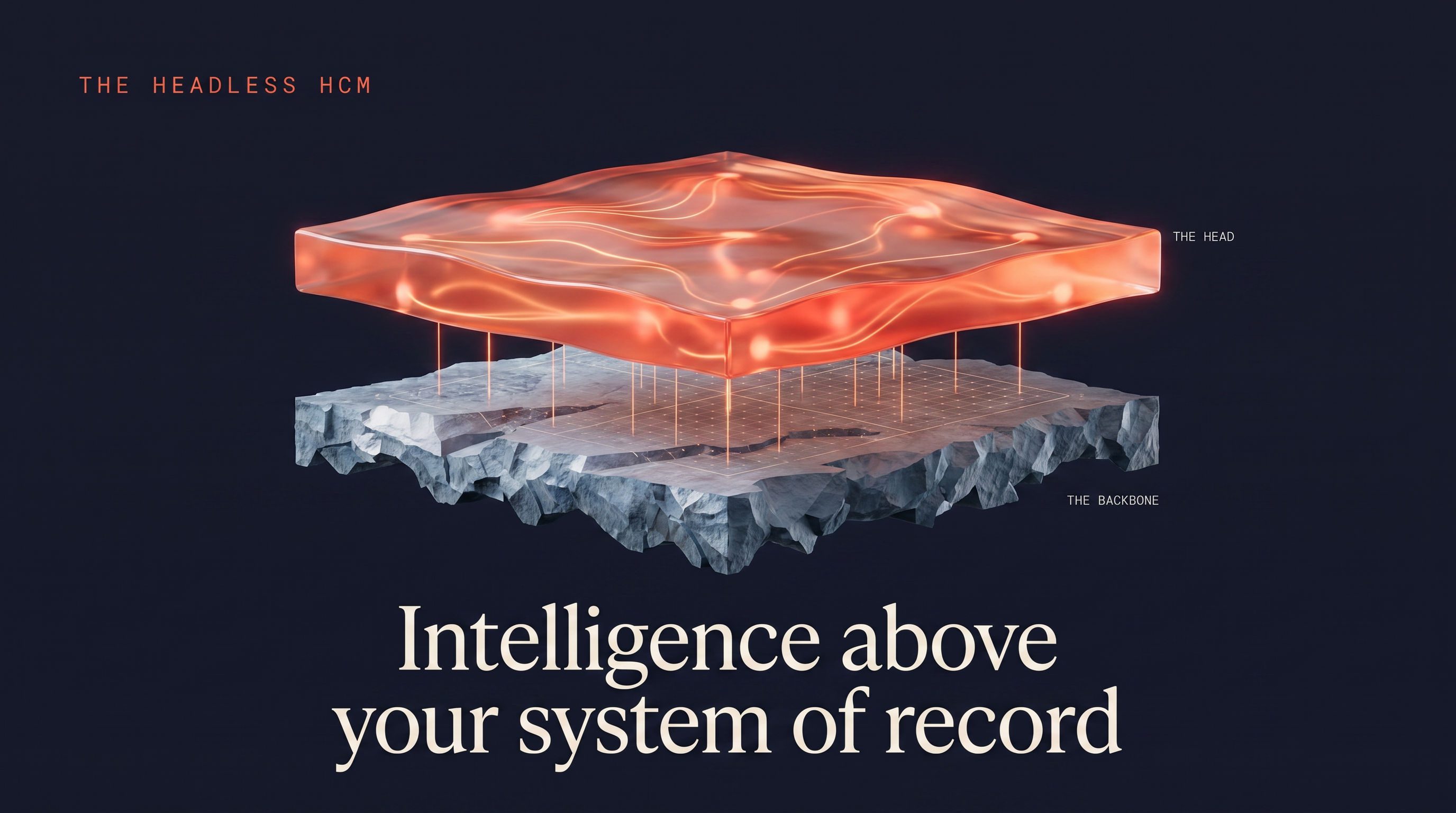
Headless architecture is already reshaping ERP. Leading technology analysts have noted that Enterprise Resource Planning systems are separating: the intelligence and the data engine – the “backbone” – separates from what users engage with, or “the head.” What remains is an easily accessible, flexible foundation over which any intelligent experience can be built.
But what about our work in HR? As it turns out, if you swap “ERP” for “HCM”, the thesis is identical.
The trend line is clear: headless CRM arrived first. Headless ERP is mid-emergence. Headless HCM is the natural third wave – and the workforce context makes it as consequential than either predecessor.
CRM data tells you what a customer might do. HCM data tells you what your entire organization can do. The combination of agentic intelligence and that depth of workforce signal doesn’t just generate reports – it enables autonomous execution at scale: real-time talent redeployment, predictive capacity modeling, skills-based matching that works without human bottlenecks.
This is workforce orchestration. Not workflow automation. Not dashboard analytics. Orchestration – where the system reasons, and takes actions toward goals, not just toward outputs.
Gloat didn’t wait for an analyst to apply this pattern to HR. We built Loomra.
Your incumbent HCM becomes the system of record – the backbone. Loomra becomes the intelligent head: the agentic layer that orchestrates workforce action across it; you have a new system of action.
The HCM doesn’t go away. It gets activated.
Why Incumbent HCMs Can’t Deliver This Alone
Incumbent HCMs were purpose-built for what they do best: structured record-keeping, compliance, and workflow administration. That architecture wasn’t a mistake, it was the right design for the problem it solved. But it comes with a fundamental constraint: everything an HCM vendor builds, including their AI agents, must be supported by their core legacy API’s. Every new capability has to work within the boundaries of what their existing product already does. That means their agents can only act on what their system was already designed to handle, and no more than that. Reasoning across workforce data, orchestrating action across systems, and operating in real time requires a fundamentally different foundation. Loomra was built AI-native from the ground up, not to replace what your HCM does well, but to add the intelligent layer it was never designed to be. Together, they do what neither can alone.
The Upgrade Treadmill Is Optional – You Just Didn’t Know It
For most HR leaders, keeping up with advancements in software has meant one thing: migration. Upgrade to the latest cloud suite. Re-implement. Renegotiate the contract. Endure the 18-month transition. Hope the new features actually ship.
That treadmill is a vendor construct, not a business requirement.
The market proved this recently when a dominant HCM vendor was forced to reverse a decision that restricted its AI agents exclusively to customers on its latest cloud suite – user pressure was simply too great. The message landed clearly: organizations don’t want to migrate to access intelligence. They want intelligence layered on what they already run.
When your intelligence and orchestration capability lives in an independent layer – connected to your HCM but not owned by it – you regain leverage. You are no longer dependent on your incumbent vendor’s roadmap for workforce AI. You are not waiting for the next release tier. You are not scoping a multi-year migration to access skills-based org design.
The architectural question CHROs and HR technology leaders should be asking is not “when do we migrate?” It’s: How do we layer agentic intelligence on what we already own?
The headless HCM approach answers it in three moves:
1. Treat Your HCM as the Backbone, Not the Brain
Your incumbent HCM is authoritative for records, compliance, and history. It was designed to do that, and should stay that way. What it was never designed to do is reason across that data, prioritize workforce action, or execute across systems in real time. That’s the intelligence layer’s job.
2. Don’t do Another Migration – Connect Intelligence through Integration
Gloat’s Loomra connects to your existing HCM via standard integrations. Goal-directed reasoning runs on top of your live workforce data. No data warehouse to build first. You don’t have to extract, transform and load millions of data points. Value begins right away.
3. Let Agentic Intelligence Handle the Orchestration
Once connected, Loomra operates as a system of action – not merely a system of insight. It surfaces flight-risk signals and suggests targeted retention moves. It identifies internal candidates for critical roles before a requisition even opens. It turns workforce planning cycles into real-time moves, freeing HRBPs to do strategic work instead of pulling pivot tables.
You deploy agentic capability on your timeline, with your data, in service of your workforce strategy.
Your HCM holds massive accumulation of workforce signals – compensation bands, org hierarchies, talent profiles, performance history, mobility patterns. That data is extraordinarily valuable. It has just been locked inside an interface built for administration, not orchestration.
Gloat’s agentic intelligence layer reads that data by design – messy history, legacy rules, and all. There is no prerequisite “we need to clean up our data” project. There is no parallel-run period where you maintain two systems. The intelligence works with what you have, from day one.
The “protect-your-investment” argument moves from being ‘resistance to change’’ to becoming a strong business case
- No migration risk. Your “system of record” stays live and authoritative.
- No re-implementation cost. Gloat connects to what you already run.
- Faster time to value. Agentic capability deploys in weeks, not fiscal years.
- Existing data activates. The workforce insight your HCM has been silently accumulating becomes the fuel for real-time workforce decisions.
What Real-Time Agentic Intelligence Looks Like in Practice With a Headless HCM
This is where Gloat’s Agentic HR comes in. It’s a layer on top of your system of record, connects to the data and workflows you already own, and turns them into real-time action, built on three core pillars:
- Loomra, the Workforce Context Engine. Loomra reasons and acts across everything your HCM has accumulated and extends that understanding across your entire HR tech stack, not just your HCM. It builds a living, connected view of your workforce and acts on it. It also inherits the workflows and business logic already defined in your existing systems, so you can extend them with agentic steps rather than rebuilding them from scratch. This is the foundation everything else runs on.
- Agents in the flow of work. Rather than another destination to log into, intelligent agents operate where work already happens, accessed directly through Microsoft Teams, Copilot, Slack, and Google. Deploy ready-made agent templates for common HR workflows, or build custom agents tailored to your organization’s specific processes, surfacing the right insight and taking action at the moment a decision needs to be made.
- Enterprise guardrails and compliance. Every action runs within the permissions, policies, and compliance boundaries your organization already enforces, with full auditability, every decision and action the agents take is traceable and reviewable. The intelligence operates with the same rigor your HCM was built to guarantee, nothing acts outside the rules, and nothing happens without a record.
Together, these pillars produce concrete capabilities, such as:
These pillars come to life through agents that span three tiers, from simple transactional helpers to fully autonomous operators, so you can start small and scale as you go:
- Transactional Single-task agents that handle volume: answering policy and benefits questions, generating natural-language reports across your HR data, keeping employee skills and profiles fresh. These are the quick wins you can deploy immediately.
- Specialists Workflow experts that own a single HR domain end-to-end and work alongside your people. An Onboarding Agent that drives new-hire ramp from day 0 to 90, a Performance Agent delivering continuous coaching and feedback, a Career Coach guiding growth and learning paths, an Internal Mobility Agent filling roles with internal talent.
- Orchestrators: Agents that act like your smartest HR operators, at scale across the organization. A Workforce Planner forecasting skill demand and capacity, a Reallocation Agent moving people to shifting priorities, an HRBP Agent partnering with business leaders, a Recruiter Agent running hiring processes.
This is what agentic intelligence produces when it runs on top of a properly activated workforce data backbone.
The Decision in Front of You
The CHRO facing an “AI Upgrade” conversation has two paths.
Path one: Scope the migration. Engage the consultants. Build the business case for a multi-year platform transition that will consume capital, organizational focus, and goodwill – with the promise of AI capability at the end of it.
Path two: Layer agentic intelligence on what you already own. Activate your HCM data without replacing your HCM. Start with 1-3 initial use cases. Achieve real-time workforce orchestration in a fraction of the time, at a fraction of the risk. Scale from there.
The headless HCM is not a workaround. It is the architecture that the organizations today require – built for leaders that cannot afford to wait on a vendor’s roadmap to drive business results.
Your workforce data is ready. Your workforce decisions shouldn’t wait.
Explore how Gloat’s agentic intelligence layer transforms your existing HCM into a system of action – without a migration project in sight.