The Real Reason Your AI Strategy Isn’t Working (Hint: It’s Not the Technology)
What 300 C-suite leaders revealed about the gap between AI roadmaps and AI results—and what CHROs need to do about it.





Here’s something that might surprise you: the biggest barrier to AI adoption in enterprise organizations isn’t budget, infrastructure, or even finding the right tools.
It’s your workforce.
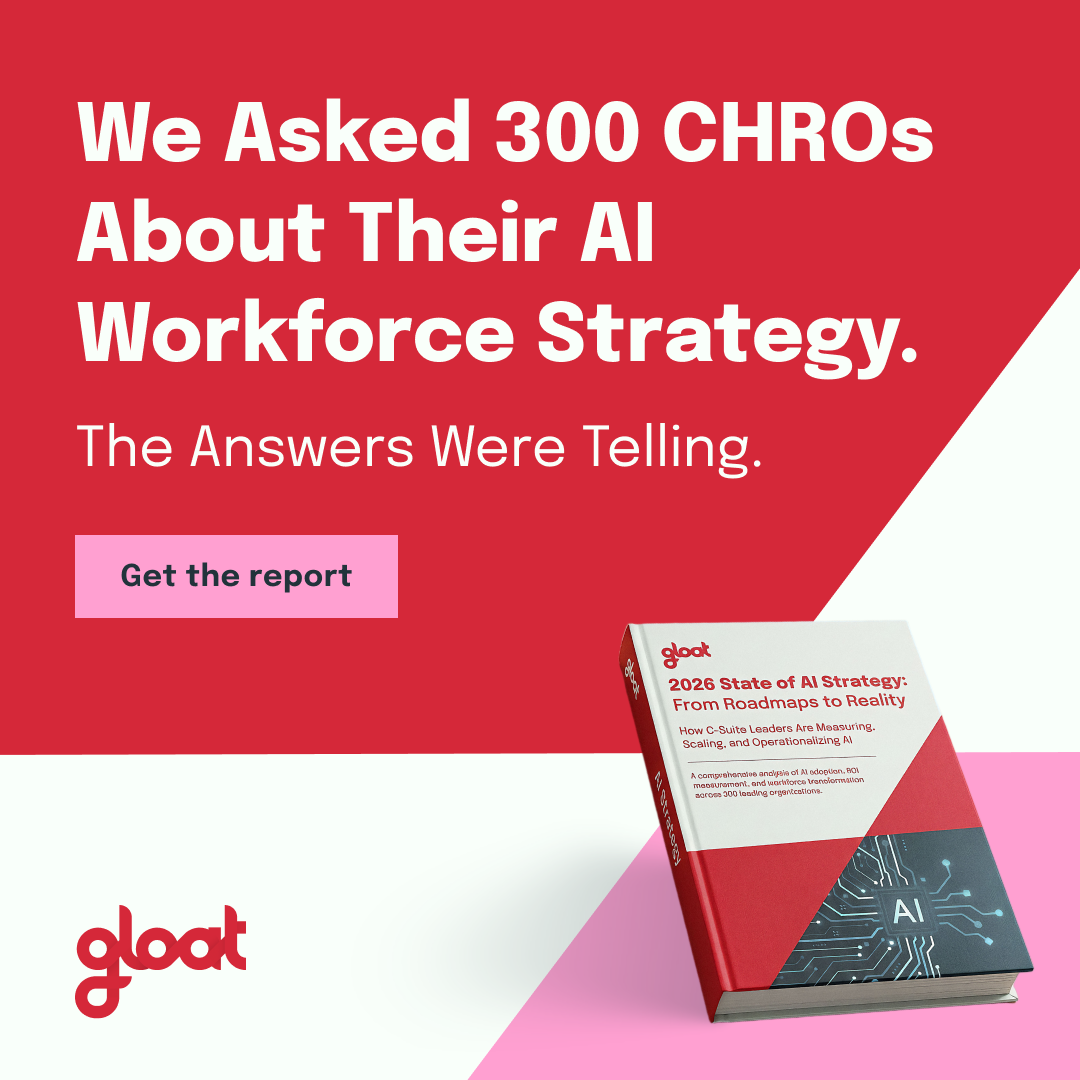
That’s the headline finding from our 2026 State of AI Strategy report, which surveyed 300 C-level executives—CIOs, CHROs, and CAIOs—across the US and UK. And while the data tells a story of remarkable progress (90% of organizations now have verified ROI for their AI initiatives), it also reveals an uncomfortable truth that every CHRO needs to hear.
The technology is ready. The question is: are your people?
The Great Disconnect: Roadmaps vs. Reality
Let’s start with the good news. Enterprise AI has officially graduated from the “experimental” phase. The days of “it’s too early to measure” are over:
- 90% of organizations now have verified, data-backed ROI calculations for their AI initiatives
- 86% have an AI roadmap in place
- 55% have successfully scaled pilots into everyday workflows
By most measures, we should be declaring victory. But here’s the problem: only 32% of leaders strongly agree that AI is truly integrated into their business strategy with measurable outcomes.
That’s a 54-point gap between having a roadmap and achieving real integration.
Where do strategies go to die? Right there—in the space between planning and execution. And increasingly, the research suggests that gap is a human one.
The Human Element: Why 42% of Leaders Are Stuck
When we asked C-suite leaders to identify their primary obstacle to AI adoption, the top answer wasn’t what you might expect:
- 42% cited skill gaps and lack of digital literacy
- 34% pointed to cultural resistance
- 32% identified UX challenges
Technology infrastructure? Only 25% saw it as a blocker.
This tracks with what McKinsey found in their latest State of AI research: 46% of leaders cite talent skill gaps as the primary reason their AI development is moving too slowly. The technology works. The problem is finding people who know how to use it effectively.
Gartner’s data paints an even starker picture: only 8% of HR leaders believe their managers have the skills to effectively use AI. Yet one in three organizations expects higher performance from employees when they use AI. That’s a recipe for frustration—and failure.
The message is clear: you can buy the best AI tools in the world, but if your workforce isn’t equipped to use them, you’re not getting the value.

The Regional Divide: Different Obstacles, Same Problem
Interestingly, US and UK leaders see different versions of this challenge.
In the US, 45% of leaders cite a lack of employee training or digital literacy as their top obstacle—compared to 35% in the UK.
In the UK, leaders are more likely to cite unclear leadership vision or communication (38% vs. 23% in the US).
Both are workforce problems. They just manifest differently depending on organizational culture and context.
Some Industries Are Feeling It More Than Others
The cultural barrier isn’t evenly distributed across sectors. Our data shows stark differences by industry:
- 50% of Energy sector leaders report being “paralyzed” by workforce resistance
- 47% of Health & Pharma leaders say the same
- Only 16% of Finance leaders report similar paralysis
What’s different about finance? Often, it’s a combination of clearer use cases (fraud detection, automated reporting), more established data infrastructure, and a workforce that’s already comfortable with algorithmic decision-making.
For industries like energy and healthcare—where AI adoption requires significant process redesign and where regulatory considerations add complexity—the change management challenge is exponentially harder.
Where AI Is Actually Working
So where is AI delivering? The answer might surprise you.
When we asked which business functions are seeing the most efficiency gains from AI, customer service and marketing—the poster children of the AI revolution—weren’t at the top. Instead:
- IT & Data Management: 63%
- Operations: 43%
- Finance: 37%
- HR / People Ops: 36%
- Customer Service: 34%
The heaviest lifting is happening in the back office. Data processing, system monitoring, infrastructure management, predictive maintenance—these are the unglamorous workloads where AI delivers immediate, measurable value.
This aligns with PwC’s 2025 Global AI Jobs Barometer, which found that productivity growth has nearly quadrupled in industries most exposed to AI since 2022—rising from 7% to 27%. The industries seeing the biggest gains aren’t the ones with the flashiest AI applications. They’re the ones systematically embedding AI into core operations.
The Confidence Gap: Size Matters
Here’s another pattern worth noting: confidence in AI readiness correlates strongly with company size.
- 38% of leaders at companies with 3,000-5,000 employees are “very confident” in their organization’s AI readiness
- 68% of leaders at companies with 25,000+ employees feel the same
Larger organizations typically have more resources to invest in training, dedicated AI teams, and change management infrastructure. They can afford to experiment, fail, and iterate. Smaller enterprises often have to get it right the first time—which creates pressure that can slow adoption.
What This Means for CHROs
If you’re a CHRO reading this, the implications are clear: AI isn’t just a technology initiative. It’s a workforce transformation initiative. And that means it’s fundamentally your problem to solve.
Deloitte’s 2025 Global Human Capital Trends research reinforces this point. They found that over 70% of workers are more likely to join and stay with an organization if its employee value proposition helps them thrive in an AI-driven world. Meanwhile, organizations that prioritize developing human capabilities alongside AI skills are nearly twice as likely to have workers who feel their work is meaningful—and twice as likely to achieve better financial results.
The companies that treat workforce development as an HR afterthought are leaving value on the table. The ones that treat it as a strategic imperative are pulling ahead.
The Three Phases of Enterprise AI (And Where You Probably Are)
Based on our research, we see enterprise AI adoption evolving through three distinct phases:
Phase 1: Validating Value
Status: Established
This is where organizations prove that AI works and generates ROI. With 90% of enterprises now tracking verified returns, most organizations have completed this phase. The business case is closed.
Phase 2: Scaling Operations
Status: Active
This is where pilots become production systems. With 55% of organizations reporting that their pilots have “mostly scaled,” we’re firmly in this phase. The focus is on operational integration, governance, and expanding use cases.
Phase 3: Workforce Reinvention
Status: The Next Frontier
This is where the real differentiation happens. With 42% of leaders citing skill gaps as their primary obstacle, this is the challenge that will define the next 3-5 years of enterprise AI.
Most organizations are somewhere between Phase 2 and Phase 3. The question is how quickly you can make the transition.
What the Winners Will Do Differently
The winners of the next 3-5 years won’t be the organizations with the best AI tools. Technology platforms will continue to improve and commoditize. The winners will be the organizations that solve the human side of the AI equation.
That means:
Treating AI upskilling as change management, not training. As McKinsey notes, companies that treat upskilling as a training rollout miss the larger point. Learning and development must be embedded in workflows, reinforced by leadership behaviors, and supported by redesigned processes and incentives.
Rethinking the employee value proposition. Deloitte’s research suggests organizations need a new EVP that accounts for how AI is transforming work. That means communicating AI’s role in job transformation, career growth, and work-life balance—and actually delivering on those promises.
Investing in skills visibility. You can’t close gaps you can’t see. Organizations need clear, data-backed pictures of where skills exist, where they’re missing, and how to develop them. This is foundational work that makes everything else possible.
Connecting the dots between AI strategy and talent strategy. Gartner recommends CHROs prepare for the future of work while driving talent results today with a “now-next” talent strategy. That means clearly defining how to get the most from your talent today (the next 12 months) while taking actions to position for where AI is heading.
The Bottom Line
The data from 300 enterprise leaders paints a picture of a corporate world in transition. We’ve graduated from the era of AI experimentation into the era of AI operationalization.
The technology works. The ROI is proven. The question is no longer if AI will be adopted, but how fast the workforce can adapt to support it.
For CHROs, this represents both the greatest challenge and the greatest opportunity in a generation. The organizations that master workforce transformation will define the competitive landscape for the next decade. Everyone else will be playing catch-up.
Get the Full Report
Download our 2026 State of AI Strategy report to check out the complete data on adoption trends, ROI measurement, scaling challenges, and workforce transformation—broken down by industry, region, and company size.