How AI Skills Management Drives Organizational Agility
Why the organizations winning in 2026 will be those who can see, mobilize, and develop workforce capabilities faster than their competitors can hire





Here’s the uncomfortable truth heading into 2026: your organization chart is lying to you. Those carefully defined roles and neat reporting lines? They’re likely fictional. Your actual workforce—the one with the capabilities to solve tomorrow’s problems—is invisible. It’s buried in outdated profiles, trapped in departmental silos, and changing faster than HR can document.
If you’re looking to pivot ahead of the curve in 2026, you must be able to answer these questions: What can our people actually do? Where do we need those capabilities most urgently? And how do we close the gap before our competitors do?
This is why skills-based organizations are 79% more likely to provide positive workforce experiences and 57% more likely to respond effectively to change. They’re not managing jobs; they’re orchestrating capabilities. And AI is the only technology that makes this possible at enterprise scale.
What is AI-enabled skills management?
AI-enabled skills management is a strategic system that leverages artificial intelligence to automate the identification, assessment, and development of employee skills, optimizing talent utilization, workforce planning, and addressing skill gaps.
Think of it as moving from a static org chart to dynamic workforce intelligence. Instead of asking “who holds which job?” you’re asking “who can do what, where are the gaps, and how do we close them?” And you’re getting answers not in weeks, but in seconds.
How AI-enabled skills management works
The power of AI-enabled skills management comes from four core capabilities working together:
Automated Skill Profiling and Inference
AI analyzes resumes, project histories, certifications, and collaboration patterns to automatically build comprehensive skill profiles. It goes further by inferring skills based on adjacent capabilities. If someone has led three digital transformation projects and holds a PMP certification, the system can reasonably infer change management skills, even if never explicitly listed. This automation gives HR unprecedented visibility into hidden capabilities across the organization.
Dynamic Skills Ontologies and Taxonomies
As Deloitte research notes, a skills taxonomy creates a common language that drives organizational agility. But skills evolve quickly, so what mattered last year may be obsolete today. AI-powered systems maintain living taxonomies that automatically update as new skills emerge, existing ones transform, and relationships between capabilities shift. When “prompt engineering” became critical in 2023, AI systems didn’t wait for HR to notice; they automatically identified it as a distinct capability, mapped it to related skills, and began tracking who had it.
Talent Matching Algorithms
AI matches people to opportunities with precision manual processes can’t achieve. Need someone with supply chain optimization experience, fluent Spanish, and SAP familiarity? AI scans the entire organization instantly, ranking candidates by fit and identifying people who are 80% there and could close the gap quickly. This isn’t just filling roles; it’s discovering talent you didn’t know existed.
Predictive Workforce Analytics
The most sophisticated systems predict tomorrow’s needs by analyzing business strategy, industry trends, and emerging technologies. They forecast which capabilities will become critical and flag gaps before they become crises—telling you not just that you’re short on data scientists today, but that your roadmap will require 40% more machine learning expertise within 18 months.
The Connection Between Skills Intelligence and Organizational Agility
Understanding what your workforce can do is necessary. Understanding it in real time is transformative. Here’s why skills intelligence is the foundation of organizational agility:
Enabling Rapid Workforce Redeployment
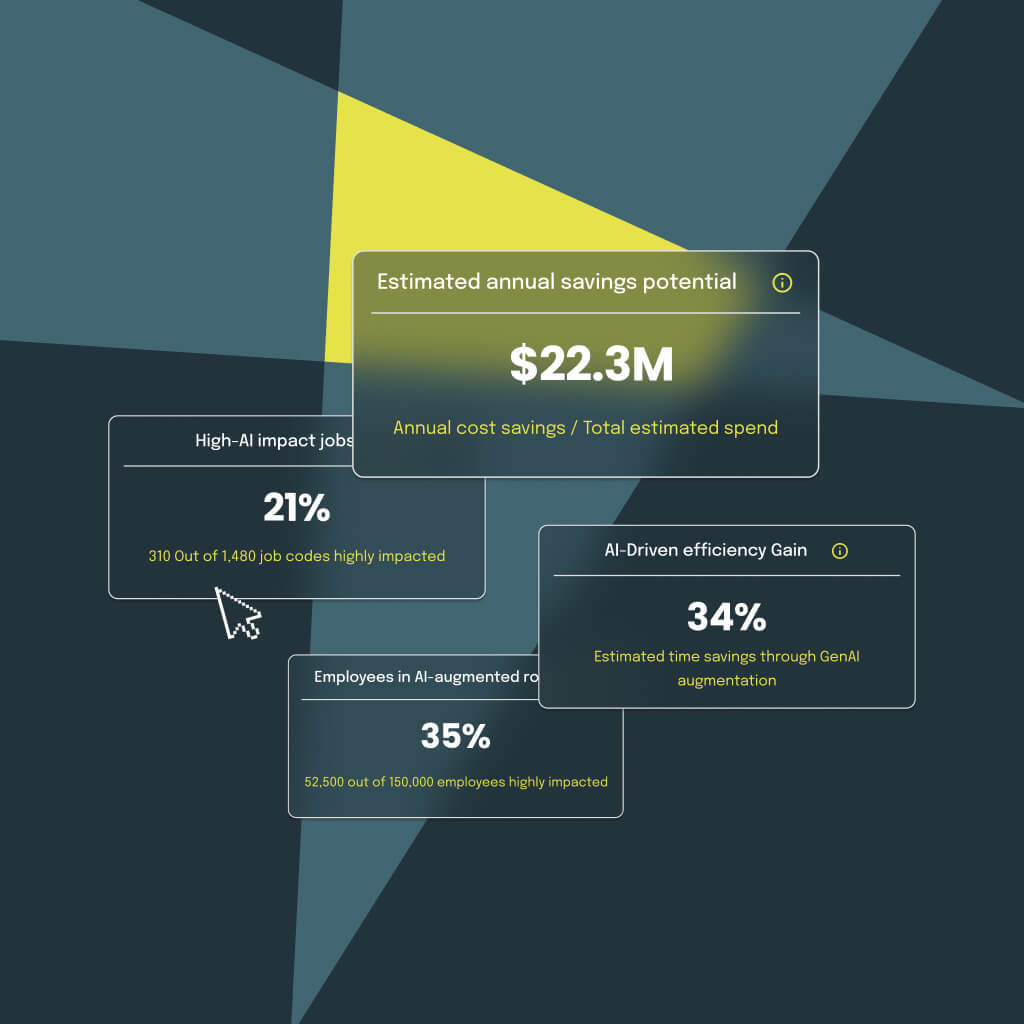
When a new product launch becomes mission critical or your enterprise acquires another company, agile organizations will forgo traditional job descriptions in favor of redeploying existing talent. AI-enabled skills management makes this possible by identifying who has the capabilities needed and who’s available to pivot. Instead of a six-month hiring cycle, you’re mobilizing teams in days. One Gloat customer using our Signal platform identified 4.8 million strategic work hours that could be redeployed to higher-value initiatives rather than absorbed by routine tasks or external hires.
Supporting Internal Mobility and Career Pathing
Skills-based organizations are 45% more likely to improve employee retention. The reason is simple: employees can see career paths they never knew existed. AI systems surface opportunities that match someone’s skills and aspirations, even in departments they’ve never considered. A marketing analyst might discover they’re a strong match for a data science role in operations. A finance professional might realize their project management skills make them a candidate for a transformation office position. This breaks down the traditional barriers to mobility: lack of visibility, departmental silos, and the “who you know” problem.
Accelerating Reskilling and Upskilling Initiatives
Generic training programs don’t work. Personalized development does. AI-enabled skills management identifies precise gaps at the individual level and recommends targeted learning, whether that’s a course, a project, or a mentor. When an organization needs to build AI literacy across 10,000 employees, the system can identify who needs foundational training, who’s ready for advanced applications, and who can serve as internal coaches. This precision eliminates wasted time on irrelevant training and accelerates capability building where it matters most.
Key benefits of AI-enabled skills management
The strategic value of AI-enabled skills management extends across every dimension of workforce strategy:
Identifying skill gaps
Skills gaps are the number one barrier to transformation, cited by 63% of employers. AI makes the invisible visible by showing not just where gaps exist, but their magnitude, urgency, and cost. More importantly, it shows whether those gaps can be closed through development or require external hiring. This intelligence transforms workforce planning from guesswork into data-driven strategy.
Personalized learning and development
One-size-fits-all training is dead. Modern employees expect Netflix-style personalization in their development. AI delivers it by recommending learning pathways tailored to individual career goals, current capabilities, and organizational needs. The result: higher completion rates, faster skill acquisition, and development that actually drives business outcomes.
Enhanced efficiency
Manual skills management is resource-intensive and always outdated. AI automates the heavy lifting by profiling employees, updating taxonomies, and matching talent to opportunities, in turn freeing HR to focus on strategy rather than administration. What once required months of surveys and spreadsheets now happens continuously in the background.
Data-driven decision making
Should you build or buy certain capabilities? Which business initiatives are at risk due to skill constraints? Where should you invest development dollars for maximum impact? AI-enabled skills management answers these questions with data, not opinions. Leaders can make workforce decisions with the same rigor they apply to financial or operational choices.
Improved talent acquisition and retention
External hiring is expensive and slow. Internal mobility is neither. Organizations with strong skills visibility hire less externally because they can see and activate internal talent. They also retain more because employees have clear growth paths and opportunities to apply their skills in new ways. Skills transparency turns the organization into a talent marketplace where the best opportunities rise to the surface.
Key challenges and considerations
AI-enabled skills management delivers enormous value, but success requires addressing legitimate concerns:
Bias in AI algorithms
AI systems learn from data, and if that data reflects historical biases, the AI can perpetuate them. Studies show that biased AI in hiring and talent management can systematically disadvantage qualified candidates from underrepresented groups. Organizations must conduct regular bias audits, use diverse training data, and implement fairness metrics. The EU AI Act now classifies HR AI systems as high-risk, requiring transparency and ongoing monitoring. Smart organizations see this not as a burden but as a mandate to build systems that are fairer than the manual processes they replace.
Data privacy and security
Skills data is personal data—and employees rightfully want control over how it’s used. Organizations must be transparent about what data is collected, who can access it, and how decisions are made. Strong governance includes clear policies on data retention, employee consent, and the ability for individuals to review and correct their skill profiles.
Need for human oversight
AI makes recommendations; humans make decisions. A matching algorithm might identify three candidates for a role, but managers must evaluate cultural fit, team dynamics, and individual readiness. The EU AI Act explicitly requires human oversight for high-risk systems in employment contexts, and for good reason: algorithms don’t understand context the way people do. The goal is augmented intelligence; AI providing insights that enable better human decisions, not replacing human judgment.
Transparency and employee trust
Employees need to understand how AI is used in talent decisions. If the system recommends someone for a role, can they see why? If they’re not selected, do they understand what skills would have made them a better match? 87% of companies now use AI in recruitment, making explainability essential. Organizations that treat AI as a black box lose employee buy-in. Those that demystify it—showing how the system works and giving employees agency in their development—build trust and engagement.
Building an agile, future-ready workforce with AI-enabled skills management
The organizations winning in 2026 and beyond won’t be those with the most employees or biggest training budgets. They’ll be the ones who know what their people can do, where capabilities are needed most, and how to close gaps with precision and speed.
The transition takes time. Building data infrastructure, establishing governance, and earning employee trust doesn’t happen overnight. But companies making this shift today are creating competitive advantages that are nearly impossible to replicate. They’re discovering hidden expertise, mobilizing talent faster than competitors, and turning every employee into a strategic asset.