Agentic HR Gets Real
What Day One of Irresistible 2026 Tells Us About the Future of Work

Contents
LIVE FROM IRRESISTIBLE 2026
USC MARSHALL, LOS ANGELES
If there was a single message coming out of day one at Irresistible 2026, the Josh Bersin Company’s annual HR leadership conference, it’s this: the era of agentic HR has officially arrived — but most organizations are nowhere near ready for it.
The gap is striking. As our colleague Heather Yurko captured in her recap of the opening sessions, 92% of CEOs are investing heavily in AI, yet we’re less than 5% into genuine business reinvention. Companies are bolting assistants onto broken processes instead of reimagining how work actually gets done. The technology is sprinting ahead. The operating model is barely walking.
That tension — between AI’s exponential capability and our human willingness to re-engineer work — was the throughline of the entire day. Here’s what stood out, and what it means for HR leaders trying to turn agentic AI from a pilot into a performance engine.
The pilot trap is real
The numbers shared on stage should give every people leader pause. Roughly 68% of organizations are still stuck in the pilot stage with AI, and a sobering 80% say they’re either not measuring impact, unsure of it, or seeing less than a 10% lift in the metrics that matter — productivity, employee experience, innovation.
Why the stall? It isn’t the models. The biggest barriers to successful agentic rollouts are decidedly human: skills and training gaps, a lack of leadership clarity, and weak change management or executive support to experiment. On top of that, more than half of the AI tools in use today are experimental and unconnected — point solutions that don’t talk to each other and don’t compound.
This is exactly where HR earns its seat. Workforce readiness, workflow integration, governance maturity, and strategic alignment on technology aren’t IT problems. They’re people problems — and they’re the difference between AI excellence and AI theater.
The CHRO becomes the enterprise AI activator
One of the day’s boldest reframes: the CHRO is now responsible for enterprise AI activation — the integration point where strategy, technology, and operations come together through people.
That’s a profound expansion of the role. It means partnering across the C-suite to lead an activation plan that diagnoses and discovers where AI can create value, secures strategic alignment and establishes governance, and then activates the organization through change agility. The CHRO who masters this doesn’t just support the AI transformation — they drive it.
Engagement is at a historic low, and management has lost its shine
It’s hard to talk about agentic HR without confronting the human reality underneath it. Employee engagement is sitting at pandemic-era lows of around 18%, and management itself has lost its allure. Roughly 10% of current managers say they would take on another managerial role — and the next generation increasingly views management as high stress and low reward.
The answer isn’t fewer managers; it’s better-equipped ones. The most valuable management skills now are leading through change and uncertainty, fluency with AI, and the critical thinking to coach others. The “supermanagers” Bersin’s research highlights build a culture of AI exploration, drive team and managerial excellence, elevate the employee experience, and — crucially — build trust. Agentic tools don’t replace that work. They amplify and accelerate it.
From 140 systems to dynamic enablement
Here’s the structural problem agentic HR is built to solve: the average enterprise runs on roughly 140 disparate systems covering 95 distinct HR capabilities. No human — and no single assistant — can stitch that together in the flow of work.
This is where superagents come in. Rather than asking employees to navigate a maze of platforms, agentic architecture connects fragmented systems and data into a unified layer of intelligence, enabling what Bersin calls dynamic enablement — continuous, personalized growth and support regardless of someone’s role or project. The future of work isn’t more software. It’s orchestration.
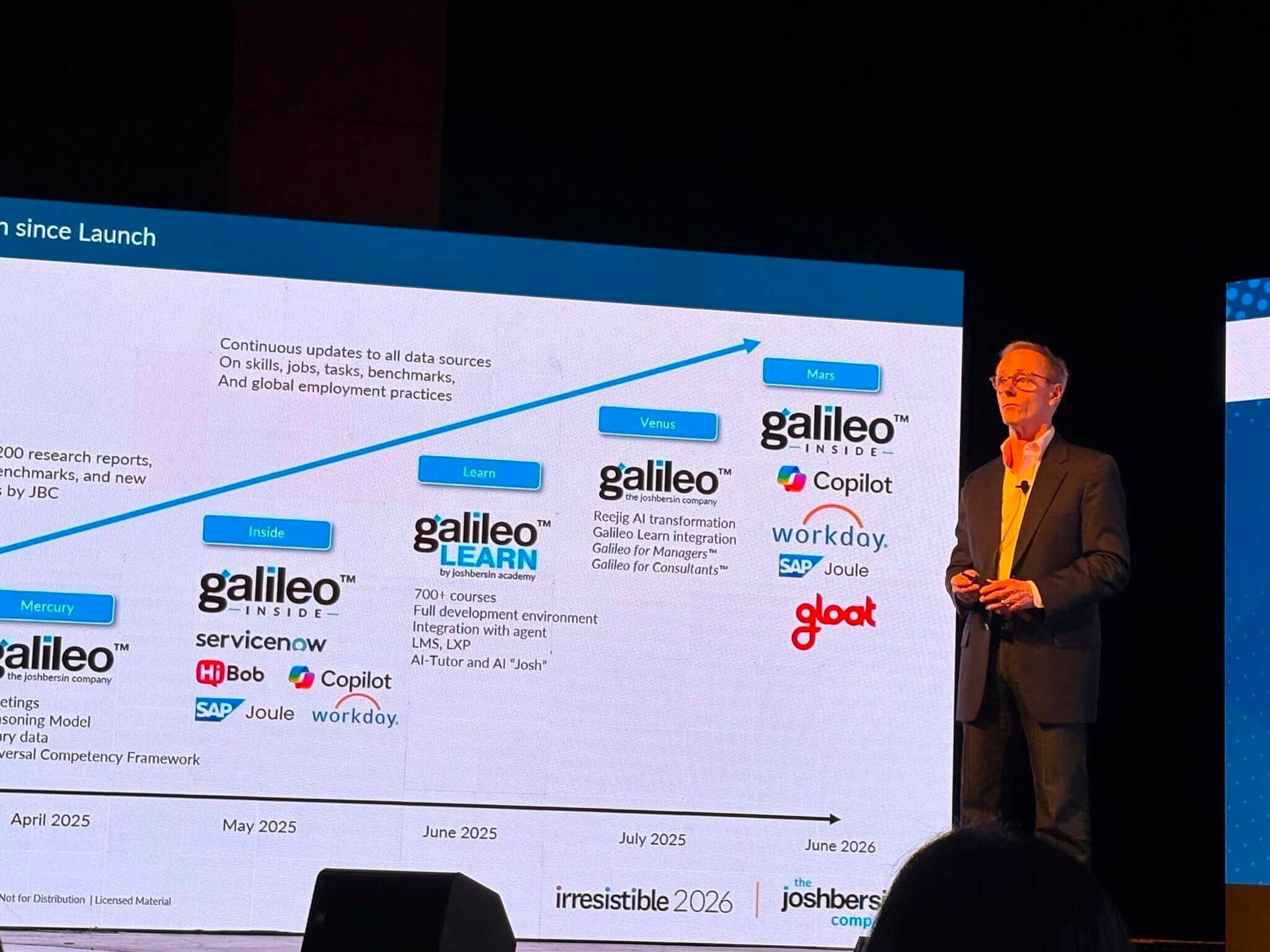
That vision was on full display in the keynote. The Josh Bersin Company’s Galileo “connected to everything” ecosystem now includes Gloat orchestrating system and data connections on top of HCMs like Workday and SAP Joule, with Microsoft Teams and CoPilot as the front end – a clear signal that the agentic HR stack is consolidating around platforms that can unify data and act on it.
The real bottleneck isn’t the technology
With token costs rising, the discipline now is to pitch high-ROI agentic projects and prove value before scaling. But the most important takeaway of the day was also the most human one: the biggest limitation to agentic HR isn’t the technology — that will keep evolving exponentially. It’s our willingness, and our ability, to re-engineer how we work.
Josh Bersin closed the day by announcing the Josh Bersin Institute, featuring a 12-credit HR certification delivered through USC Marshall Executive Education — a sign of just how seriously the profession is investing in the capabilities this moment demands.
What this means for HR leaders
Agentic HR is no longer a thought experiment; it’s a 2026 operating reality, and the HR 2030 vision Bersin laid out is closer than four years away. The organizations that win won’t be the ones with the most AI tools. They’ll be the ones that connect their systems, equip their managers, establish governance, and have the courage to redesign work around agents instead of automating yesterday’s processes.
At Gloat, this is the problem we’ve been building toward — agents for internal mobility, talent sourcing, succession, workforce insights, and reskilling that sit on top of your existing systems of record and your fragmented data in spreadsheets and on websites – and turn it all into governed action. Day one of Irresistible made the case better than any pitch could: the technology is ready. The question is whether we are.
If you want to go past the vision and into the architecture, Josh Bersin is doing exactly that with us later this month. On Wednesday, June 24, he joins Gloat for a live webinar, “Josh Bersin Unpacks the Architecture of Agentic HR,” mapping what HR actually runs on by 2030 — and why context, not more agents, decides who gets there.

LIVE WEBINAR
Wednesday, June 24, 2026 | 9 AM PT | 12 PM ET
Josh Bersin Unpacks the Architecture of Agentic HR
Agentic HR is no longer a forecast — it’s an architecture. Josh Bersin and Gloat map the agentic HR stack, the context layer underneath it, and the road to 2030, built on the systems you already own.
| Want to go deeper on building your own agentic roadmap? Explore how Gloat’s agentic HR platform → connects your workforce data and systems into a single, action-ready layer of intelligence. |