From Vision to Action
Inside the Loomra Reveal at Irresistible 2026


Contents
LIVE FROM IRRESISTIBLE 2026 · PART 2
USC MARSHALL, LOS ANGELES
In part one, we wrote that day one of Irresistible 2026 made the case for agentic HR as a 2026 reality — and that the real bottleneck isn’t the technology, it’s our willingness to re-engineer how we work. By the back half of the conference, the conversation moved from why to how. The vision got a working demo.
That demo had a name: Loomra, Gloat’s agentic HR platform. And watching it run live — connected to real HR systems, acting inside Microsoft Teams, building a succession plan in minutes — was the moment the HR 2030 vision stopped being a slide and started being software.
What Loomra actually is: three pillars
Gloat COO Shlomo Weiss broke the platform down into three core pillars, and they map almost exactly onto the gaps day one exposed.
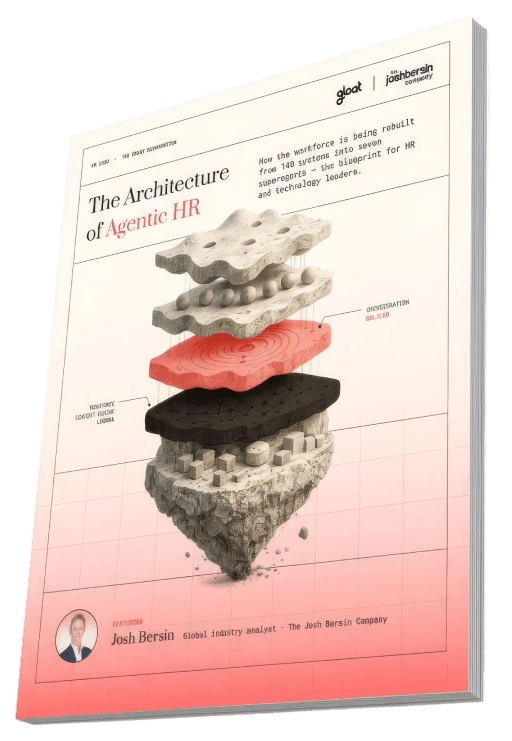
1. Workforce context. Loomra sits on top of your existing HR systems — SuccessFactors, Workday, Oracle, any HCM — and ingests the data into a strong AI semantic layer that understands how a person relates to a job, a skill, a capability, and the work that needs to get done. This “workforce context engine” is the part Gloat has spent years building, and it’s the foundation everything else stands on.
2. Meeting employees in the flow of work. Josh Bersin’s research put the number at roughly 145 employee-facing systems in the average organization. As Weiss put it on stage, “We do not want to be system number 146.” So instead of asking people to log into one more tool, Loomra’s agents come to them — inside Microsoft Copilot and Teams, Slack, Gemini, or whatever application they already work in.
3. Guardrails. This is the part that makes agentic HR safe to deploy. Loomra enforces business rules, compliance, and full auditability and observability, so agents act within the policies each organization sets — not in a free-for-all. Governance isn’t a feature bolted on at the end; it’s a pillar.
The partnerships: an adviser that can act
The most important idea from the session was how Loomra combines with its partners to close the loop between insight and execution.
The Josh Bersin Company’s Galileo brings the best practices and research — effectively the world’s top HR consultant at your fingertips. Loomra brings the deep workforce context and the connection to your own ecosystem. Bring the two together, Weiss argued, and you have “an incredible adviser with the ability to execute immediately across the organization, at scale.” An adviser that can act is a categorically different thing from a chatbot that can only suggest.
The Microsoft partnership goes deeper than distribution through Copilot and Teams. Loomra also integrates with Microsoft WorkIQ, which — where permission is granted — captures work context: calendars, email, the projects someone is actually working on. Pair that work context with Loomra’s workforce context, and you get a remarkably clear picture of where employees are spending time, where they have gaps, and where they need help. It’s the same signal our Workforce Insights Agent is built to turn into AI workforce insights leaders can act on.
Seeing it live: AI succession planning that doesn’t sit in a drawer
The demo that landed hardest was succession planning — precisely because everyone in the room knew how broken the old version is.
Weiss described the familiar ritual: once a year, an HR leader and a business head sit down, and the people who make the list tend to be the few thousand already inside their circle of influence — out of, in the example given, 80,000 employees. By the time the exercise is done, it’s already out of date.
Loomra runs it differently. Asked to build a succession plan for an SVP of Innovation Engineering, it pulled best practices from Galileo’s corpus, used semantic retrieval across the HCM and adjacent systems to surface the strongest internal successors, enriched the slate with inferred skills and what those people are actually working on, and ran compliance checks — then messaged a candidate in Teams to kick off a leadership development plan. The output included coverage lanes, individual fit and rationale, suggested upskilling, and a visual skills-gap analysis showing which tasks could be automated or augmented by AI. That is succession planning with AI in practice, and it’s the job our Succession Management Agent was built to do — with internal mobility as the path between the plan and the person.
A second demo showed a proactive agent reaching out to an employee whose skills profile hadn’t been updated in four months — then asking permission to check their Microsoft 365 activity to fill the gaps, with access governed entirely by the company’s guardrails. It’s a direct answer to the complaint every HR team voices: we don’t have enough information about our people.
“I want people doing people work”
For all the architecture talk, the line that stuck came from Heather Yurko, an HR leader on stage, describing what this changes day to day. With AI agents for HR watching for the signals — someone on a succession slate leaves, or sits on five plans across regions no one cross-checks — the work inverts: requisitions can open automatically within budget rules, L&D gets pointed to the right learning plans, and recommendations arrive in a Teams chat.
I am not actively digging. I am having data and recommendations brought to me, and as a people person, I can do people work.
That’s systemic HR made operational — and it reframes agentic AI in HR not as a way to shrink HR, but as a way to give it back to the humans.
The honest caveat — and what’s next
Josh Bersin grounded the excitement with a dose of realism: the technology is still maturing. “This Frontier tuning stuff Microsoft is doing is very new,” he noted, “and that’s going to be a huge part of this.” The architecture of 2030 is becoming clear; the tooling underneath it is still being built.
Gloat’s answer to the “how do we start” question was the Agentic HR Innovation Program — hands-on workshops to identify high-value use cases and deploy agents inside your own environment in a limited scope, with real employees interacting with them. Interest was immediate: the program booked out almost as soon as it was announced.
Day one of Irresistible argued that the technology is ready and the question is whether we are. Day three answered with a name, a demo, and a clear next step. The architecture is here. Loomra is what it looks like in action.
| Want to see the agentic HR platform behind the demo? Explore how Gloat’s agentic HR platform → connects your workforce data and systems into a single, action-ready layer of intelligence. |